



Ten best practices for the conversion funnel
Damien Fournier
· 9 min
The conversion funnel is the link between your visitors and your business’s revenue. Every parameter around it has to be measured to the millimetre, so as to maximise the conversion rate at each stage — from the top of the funnel to the last step, which generates profit for your company.
Swipe left to read
Keep reading
The conversion funnel is the link between your visitors and your business’s revenue. Every parameter around it has to be measured to the millimetre, so as to maximise the conversion rate at each stage — from the top of the funnel to the last step, which generates profit for your company.
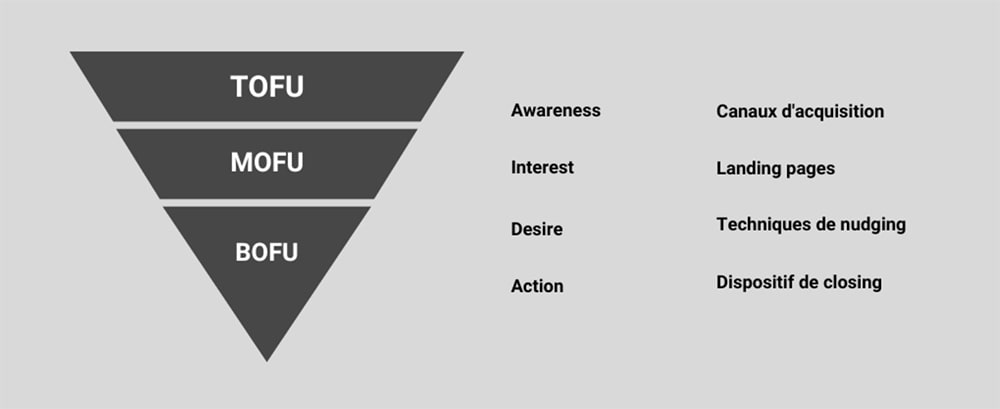
We speak here mainly of online business. The stages of the funnel are therefore defined as follows: TOFU, MOFU and BOFU.
TOFU: top of funnel — where the visitor enters and discovers your company and what you have to offer.
MOFU: middle of funnel — the moment trust with the visitor is created. They know your brand and wonder whether to commit to you. It is a strong moment, where you have to stir interest, and the ideal moment to build a connection.
BOFU: bottom of funnel — the decisive stage that leads to the decision. At this point the visitor has to be encouraged to act.
From the top to the base of the funnel, four stages stand out in the visitors’ experience:
- Awareness
- Interest
- Decision
- Action
And in online business, the tools that move a visitor from one state to the next are, in most cases:
- Acquisition channels
- Landing pages
- Nudging techniques
- Closing arrangements
In short, it looks like this:
Every stage of the funnel has its tools, from the acquisition channels to the closing arrangements
The conversion funnel of year online business in three stages (TOFU, MOFU, BOFU), set against the AIDA steps of the visitor’s experience and the tools that move them from one state to the next. A diagram, with no data. Hover, tap or step through a stage with the keyboard to read its purpose.
Best practice 1 holds for the whole funnel; number 5, loyalty, comes after the closing. With the keyboard: Tab, then the up and down arrows to move from one stage to the next.
Source: Bright, “Ten best practices for improving your conversion funnel”, March 2023; diagram redrawn from the article’s figure · Chart: bright.swiss
Now that we have taken the conversion funnel apart, we can set out the ten best practices, placed at the strategic points that get the most out of the user’s journey through your funnel.
Our top ten:
- One funnel per audience and per offer
2. Simplify the conversion and the first contact
3. Reassure the visitor: social proof
4. Fit your funnel to the occasion and the user’s buying situation
5. Loyalty is how you get the most from your customers
6. Improve how your teams handle prospects
7. Use marketing automation
8. Show your product in action
9. Analyse your visitors’ behaviour continuously and adapt your funnel
10. Personalise the customer relationship
1. One funnel per audience and per offer
Overall
Before anything else, to build an effective funnel you have to study your target prospects and their needs. To make the funnel as effective as it can be, you have to concentrate on solving a single problem, by putting a single one of your products or services forward. By presenting one offer, you channel the strength of your argument and of the conversion mechanism, without distracting your prospect from the action sought: conversion.
2. Simplify the conversion and the first contact
MOFU / BOFU, AIDA: interest, landing page
Get to the point. Keep in mind that you are asking your user to commit; committing calls for conscious effort and creates stress that can be considerable. The process therefore has to be made smooth: ask for as little information as possible, offer as few options as possible, and choose the clearest verb for your single call to action, which opens the next stage of your funnel. That was the choice made on the landing page built for Oculus: stripped back, with a single CTA, clear and repeated.
3. Reassure the visitor: social proof
MOFU / BOFU, AIDA: decision, landing page
You have to show the user they can trust you — through the seriousness of your company, and through how well your offer solves their problem at a reasonable price. Nothing is more convincing than putting forward testimonials from other users who faced the same difficulties or needs, who chose your offer and who are satisfied with it.
There are many ways of gathering your customers’ reviews, sorting them and presenting them effectively through your funnel.
You can simply gather a few and put them forward as quotes on your landing page; that method is the least effective of all, because it is easily falsified, and it is therefore hard to build strong trust on those testimonials.
Rely instead on solutions that act as a trusted third party, such as Google reviews or Trustpilot, and put those forward on your landing page.
4. Fit your funnel to the occasion and the user’s buying situation
TOFU / MOFU, AIDA: awareness, acquisition channels / landing page
You have pinned down your ideal prospects?
Now look at their habits.
It is sound to sort prospects by the need identified, while taking the occasions and the buying situations into account.
Creating filters based on buying occasions is one of the variables of the behavioural segmentation of your audience. It means establishing on what occasion your prospect will look at your offer. Is the need urgent? Is it a one-off need or a recurring one? Is it a universal occasion (Christmas, Valentine’s Day, Black Friday) or a personal one (a birthday, a wedding, a move)? In practice, that lets offers and messages be more or less personalised to the occasion, and lets complementary offers or fast-delivery guarantees be promoted, so as to encourage visitors to buy and to keep them.
The buying situation, for its part, is a behavioural segmentation based on the physical and social environment, the time of day, and the time the consumer has. Analysing the kinds of buying situation lets you fit the message, the kind of argument and the length of the argument — and also how it sits against the environment in which your prospect is reading (the device used, whether a video with sound can be watched, and so on).
By answering those two variables well, you make your conversion mechanism easier to use.
5. Loyalty is how you get the most from your customers
Post-closing
Your prospect has become a customer? Well done. But it is not over.
Depending on the nature of your business, this stage can be crucial — and in every case it should never be played down.
You have certainly spent a certain amount on acquiring that customer, but also on the human time that closed the sale, or simply on building and maintaining your funnel. Depending on your product’s margin, that conversion may not be enough to generate a profit.
This is where lifetime value per customer comes in, and therefore where loyalty is key.
Here we can mention marketing automation, a powerful weapon for loyalty if you use it together with:
- cross-sell (suggesting a product tied to a purchase made or in progress)
- upsell (recommending a higher, more expensive and better version of a product or service)
- downsell (offering an alternative product or service with minimal features at a lower price).
A plan of promotions, discounts or special offers timed to the key moments of a customer’s life lets you, in most cases, prevent attrition and get the most lifetime value from each of your customers.
Finally, referral programmes turn your customers into ambassadors, which cuts the cost of acquiring new customers while raising the lifetime value of existing ones.
6. Improve how your teams handle prospects
BOFU, AIDA: action, closing arrangements
If your funnel aims to generate prospects with a closing arrangement through a sales contact, the meeting has to be framed and improved through feedback and reporting processes from your teams.
The aim is to be able to quantify customers’ objections precisely, and to let your phone scripts answer them effectively when they recur too often. The result has to feel organic, while letting your people answer every eventuality quickly and effectively.
To that end they have to know the buying journey intimately, and your CRM has to hold everything needed to manage easily a feedback process that mixes quantitative and qualitative data.
Favour CRMs built around sales pipelines — Salesforce, SAP, Oracle or Pegasystems, depending on your company’s size. They have the particularity of using the quantitative data tied to lead qualification in one of your pipelines, while allowing qualitative studies that improve your closing.
Once those studies are done, you can quantify your objectives in return:
- The optimal time to contact a prospect
- Volume of conversions
- Conversion rate
- Call duration
7. Use marketing automation
BOFU, AIDA: decision, conversion mechanism
Your funnel did not hit the mark first time?
While you analyse why and apply the necessary changes, you still have a formidable weapon for converting that prospect: marketing automation.
Although already covered in point 5 under loyalty, marketing automation also plays an important part in converting a first purchase.
To use it, you first have to obtain one of your prospect’s details — an email or a phone number.
Then place the triggers needed for segmentation, from your prospect’s progress through your funnel and their behaviour towards your approaches.
A few examples of marketing automation lists:
- Welcoming the customer
- Birthday
- Abandoned basket
- Feedback and recommendations in exchange for a promotion
- Re-engagement and special promotions by churn risk
8. Show your product in action
MOFU, AIDA: interest, landing page
“A picture is worth a thousand words” — all the more so when you have to convince quickly.
Visual elements have to be part of your argument: a screenshot, an animated GIF or a presentation video are all reassurance, and a way for your prospect to picture themselves using your product or receiving your service.
If you can, letting your prospect have a demonstration session is most often a game changer for winning the conversion. If you sell a SaaS solution, allow the use of a demonstration account, for instance.
If that is hard to arrange, organise a video demonstration with a salesperson through simple scheduling solutions such as Calendly. That way the prospect can picture themselves using your product or service while asking their adviser questions.
9. Analyse your visitors’ behaviour continuously and adapt your funnel
MOFU / BOFU, AIDA: decision / action, landing page / conversion mechanism
Between the traffic acquisition platforms, your web analytics tools and your CRM, every stage of your funnel has to be monitored and analysed scrupulously, so as to find the pain points and bottlenecks of your final conversion rate.
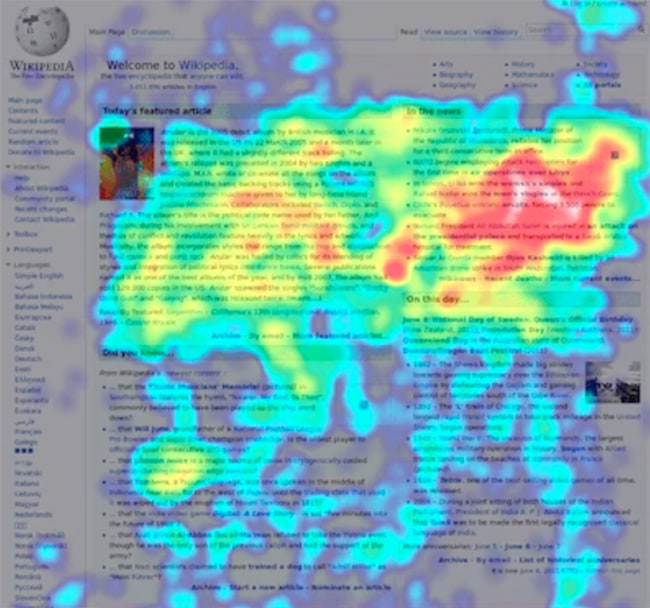
To that you can add further analysis tools that give precious data about how your users behave in your funnel: heatmaps and clickmaps.
Those tools show the user’s activity on your pages:
- How far they scroll
- Where the mouse travels
- Which elements appear on screen, and which do not
That way you can follow precisely which arguments and mechanisms hit the mark, at which moment, and which do not interest your prospect — or even drive them away.
10. Personalise the customer relationship
MOFU, AIDA: interest / decision, landing page
Depending on your industry, some of your prospects will need human contact before they can consider going further down your funnel.
There are several ways of putting a human face on your funnel, at different moments:
Live chat:
Sometimes answering quickly in a handful of characters is enough to unblock a situation, while showing your commitment to supporting your customers. Most chat solutions also include chatbot technology, which lets you filter the cases where your teams need to step in, while informing the prospect effectively. Worth noting: Salesforce, Zendesk and Landbot.
Handle inbound calls or set up a call-back:
Whether to solve a problem or to look for more information, phone calls remain an important channel, through the speed of the exchange and the human contact they allow. Inbound calls can come at different stages of the funnel, and it matters to handle them as responsively as possible. By installing a call-back system — a button, a pop-up or a form — a visitor, prospect or customer can reach the company and ask to be called back as soon as possible. That raises their satisfaction while making inbound requests easier to manage.
Conclusion
The conversion funnel is a key element of any successful marketing strategy.
By following the ten principles above, any company can improve its funnel and raise its chances of conversion.
Using social proof to reassure the visitor, marketing automation, or personalising the customer relationship can all prove excellent strategies — but first of all it is crucial to analyse visitors’ behaviour and identify the points of friction in the funnel, so as to settle on fitting solutions that smooth the transitions between the top of the funnel and the conversions. Conversion rate optimisation (CRO) is part of the work of our Commerce teams.
Going further
- Performance management19 publications
The key skills bright can bring to you