


Structuring your Meta account for performance
Baptiste Causse
· 7 min
The account follows the logic of the acquisition funnel: four or five campaigns, one to test creative and one to scale the best. The structure fits each business; the thinking behind it is universal.
Swipe left to read
Keep reading
The account follows the logic of the acquisition funnel: four or five campaigns, one to test creative and one to scale the best. The structure fits each business; the thinking behind it is universal.
Introduction
For most digital companies, Meta is a channel you cannot ignore when acquiring new customers. To benefit from its full potential, structuring your account well is essential to performance.
Having taken over several Meta accounts, it has to be said that few advertising accounts have a campaign structure that lets performance be maximised. Many times I have seen accounts with haphazard structures: several campaigns, a great many different ad sets and too few creatives, with no real logic behind them. That weighs on an account’s performance.
Many ad sets, for instance, often means many different audiences, which raises the chance of audience overlap — and that can hold back the delivery of our ad groups, and so weigh on the account’s performance as a whole. That is what we found auditing QoQa’s Meta account, where the fragmentation of campaigns was limiting the algorithm.
That is why having an account structure that is clear, simple and fitted to the business is essential to maximising performance.
Theoretical concepts
Whatever the kind of business, two theoretical concepts have to be kept in mind: the marketing funnel, and the content marketing matrix.
The marketing funnel, or acquisition funnel
Definition
The acquisition funnel, or “marketing funnel”, represents a customer’s path to purchase. It brings out the stages your potential customer passes through, between the moment they discover your brand and the moment they buy.
It generally has three stages (TOFU, MOFU, BOFU):
- Awareness (TOF): the aim of this stage is to make your brand or your product known to prospective customers. At this stage, the prospect knows nothing about you.
- Consideration (MOF): the aim of this stage is to create contact with the prospect. They know your brand and begin to trust your products. At this stage the prospect knows you and has shown interest. They may become a customer, but most of the time that is not yet the case.
- Conversion (BOF): the aim of this stage is to sell your product. The prospect becomes a customer because they have passed every earlier stage. They trust your brand and your products, and they buy. The stage that follows will be keeping them.
Every stage of the funnel has its objective: become known, create a contact, sell
The three steps of the buying journey, from discovering the brand to the purchase, and what each one has to achieve. A diagram, with no data. Hover, tap or step through a stage with the keyboard to read its objectives.
With the keyboard: Tab, then the up and down arrows to move from one stage to the next.
Source: the article’s acquisition funnel and its original figure · Chart: bright.swiss
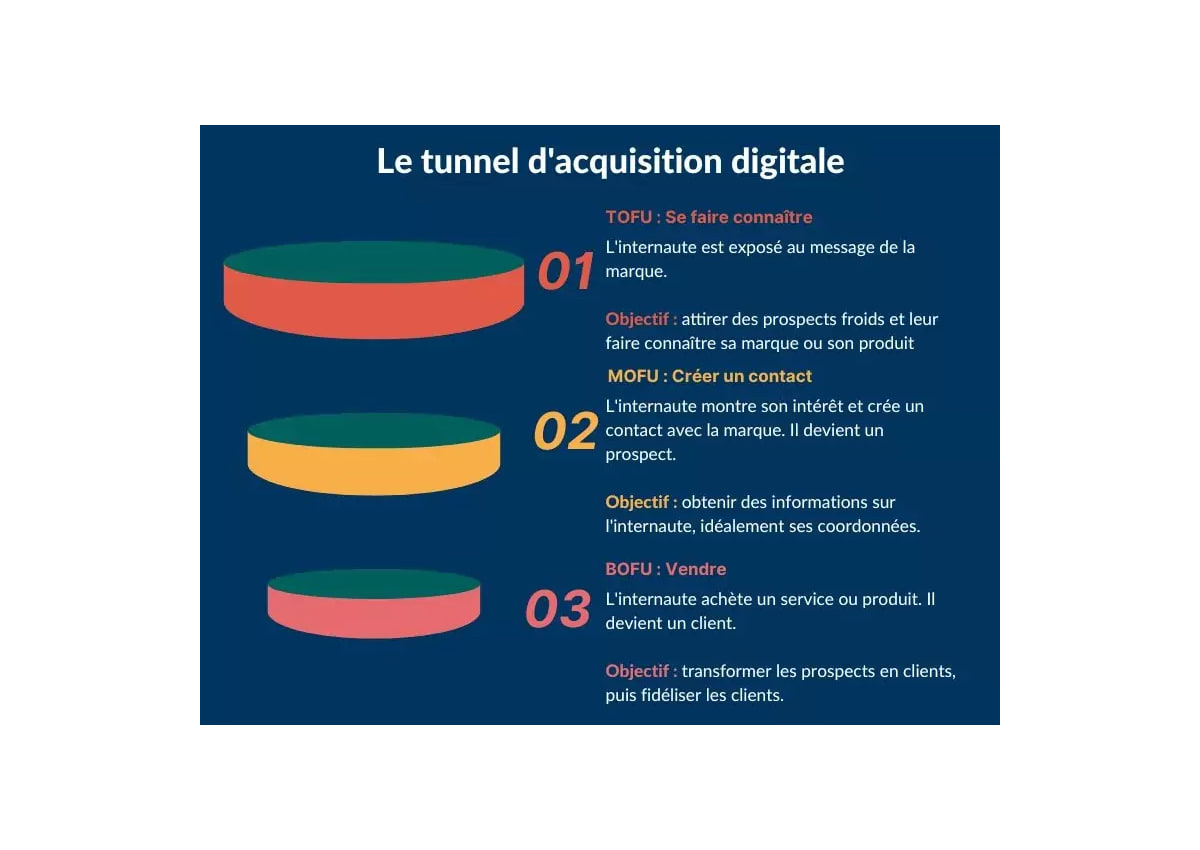
The digital acquisition funnel.
How to apply it to Meta?
Simple enough. Our account structure will follow the funnel’s logic, so we will have:
- Recognition: in this campaign we seek to make as many people as possible aware of our product or brand. Often with a video view objective, this campaign serves to reach as many people as possible at low cost. It is not compulsory, but it can prove very effective in certain cases — an expensive product, for instance.
- Acquisition: here we seek to acquire quality cold traffic, or customers. These conversion campaigns target people more likely to convert, who will either grow more familiar with our product or convert.
- Remarketing: with remarketing campaigns we seek to convert all our potential customers who have not yet converted. Best practice here is to use a message different from the other stages of the funnel — a promotional offer, a message of urgency and so on.
- Retention: these campaigns seek to keep our current customers. The aim here is to raise the LTV, the lifetime value.
The content marketing matrix
Definition
The content marketing matrix is a marketing tool for generating content against the stage of the customer journey. It is a genuine generator of content ideas and follows logically from the acquisition funnel, since it takes the stage the prospect is at (TOFU, MOFU, BOFU) into account, so as to fit the kind of content.
The matrix divides into four parts: entertain, educate, inspire, convince.
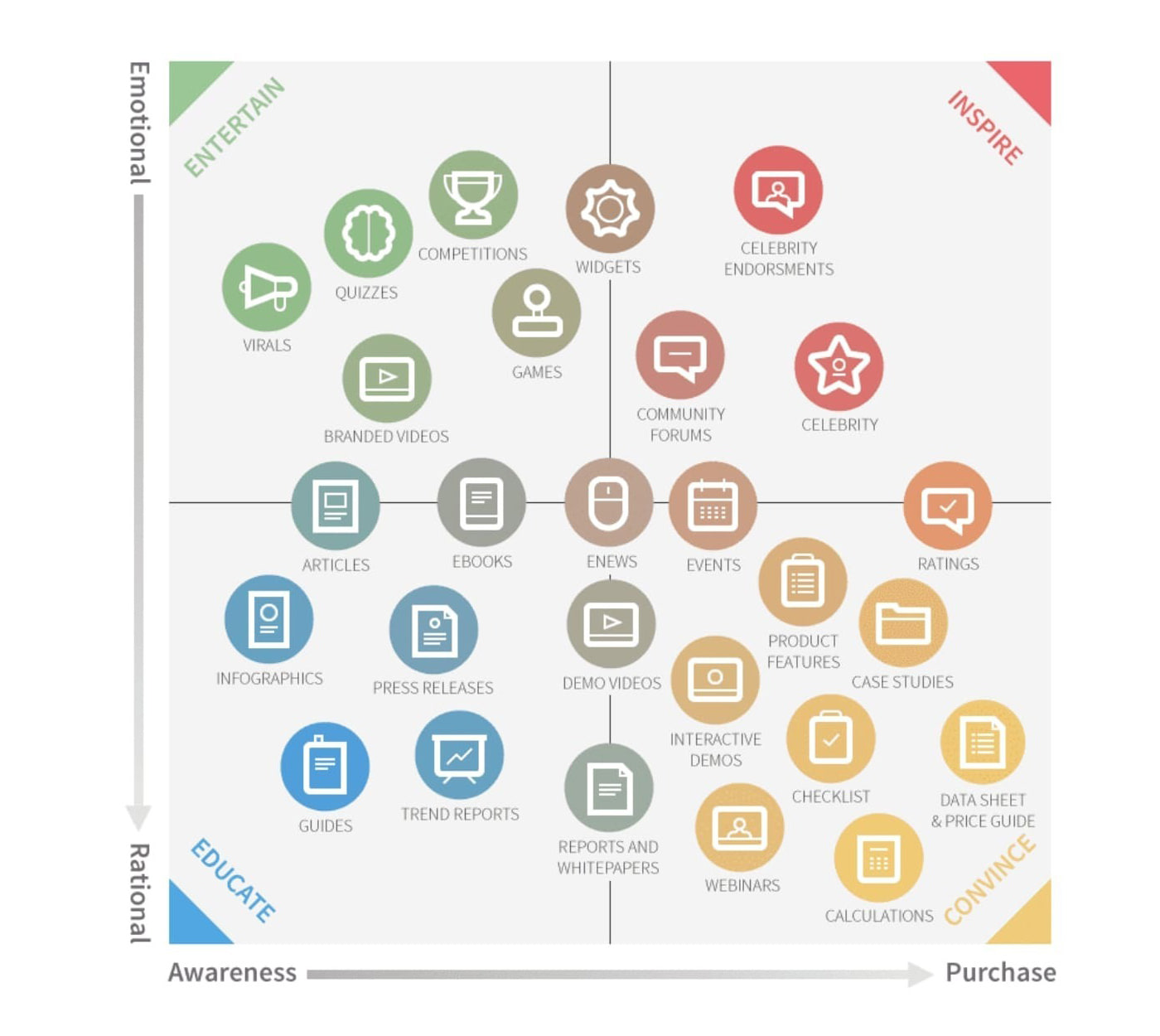
Depending on the stage of the acquisition funnel, the matrix offers fitting content, so as to speak to people as relevantly as possible.
How to apply it to Meta?
As we said, the matrix is a genuine content generator. It is very useful and follows on from the acquisition funnel, since it lets us generate creative fitted to each of the campaigns set out above.
Of course, like any theoretical concept, the matrix is there to guide the creative process — it must never replace your common sense. If a kind of creative does not fit the matrix, that is not a problem. Quite the opposite.
In short, the first concept is essential to structuring your account. The second will help you generate ads from different angles, fitted to that structure.
The Meta account structure
Now, going into Business Manager and applying the models we set out, we get four or five campaigns:
- TOF – a “Recognition/Traffic” campaign
- MOF – an acquisition campaign, “Conversion Testing”
- MOF – an acquisition campaign, “Conversion Bests/Scaling”
- BOF – a remarketing campaign
- Visitors
- IG/FB interactions
- Video views
- ATC & IC
- A retention campaign (depending on the kind of business)
The Bests campaign, which scales the best creative, takes 60 to 70% of the budget
The Meta account’s four campaigns, their objective and their ad sets; budget shares according to the article. A diagram, with no data. Hover, tap or step through a campaign or year ad set with the keyboard to read its role.
The “Europe” campaign of the original figure is the remarketing one (BOF): its ad sets are the audiences the article targets there. With the keyboard: Tab, then the arrows to move from one campaign to another (left, right) or to its ad sets (up, down).
Source: the article’s account structure and its original figure · Chart: bright.swiss
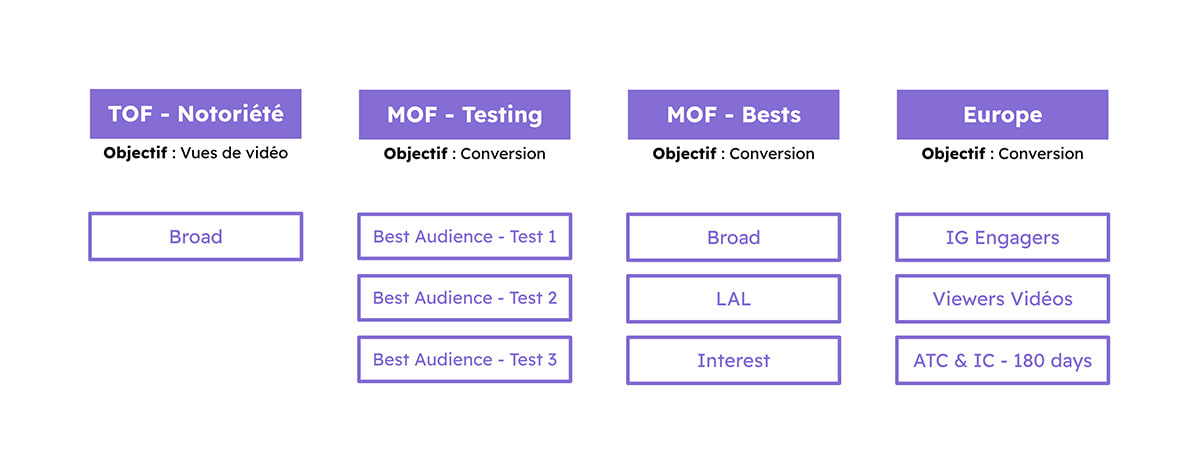
Recognition campaign – video views – (TOF)
As we said, this campaign serves to put our product or brand in front of as many people as possible. I generally like a campaign with a “video views” objective, because the cost per video view is well below the cost per click on a conversion campaign. As long as the video is of quality, short and well paced, we build a quality pool of audience that will feed our campaigns further down the funnel.
- Objective: put our brand or product in front of as many people as possible
- Bidding strategy used: highest volume
- Budget management: ABO
- Share of budget: 5%
Acquisition campaign – conversion – testing (MOF)
This campaign, rather in the middle of the funnel, serves to test and find new visuals that perform. We know today that creative is responsible for much of an account’s performance — some say 50%, others 70%; whichever it is, its impact is considerable. It is therefore essential to test new creative regularly, once a week if possible. I generally like creating one ad group per visual angle. Note that I test my creative only, so I never vary my audience. I test all my creative on my best audience. Another important element I am particularly fond of is testing creative with a cost cap bidding strategy. The cost cap limits the impact on the account’s budget overall: Meta will spend your money only if it judges the creative you gave it has potential. If it does not, it will spend little or nothing.
The limit of the cost cap here is that this bidding strategy removes the principle of seasonality entirely. A creative may well have potential, but at the moment you launched it the timing was wrong, and Meta therefore judged it had none. To avoid that bias you can choose Highest Volume — but then you will have to watch your spend.
- Objective: test our creative regularly, so as to have paths to growth
- Bidding strategy: cost cap
- Budget management: ABO
- Share of budget: 10-15%
Acquisition campaign – conversion – bests (MOF)
This is our scaling campaign — our accelerator of growth. We seek to isolate our best-performing creative in a single campaign, so as to go after volume of conversions within the objectives set (ROAS, CPA). We always use the same campaign, with audiences that have already proved themselves. In this campaign we can also seek to test new audiences. We isolate the audience variable by testing it with our best ads; if it does not work, it is the audience that does not perform — since we know our ads do.
Update, September 2026: with Andromeda, Meta handles much of the targeting, and it is now the creative that carries most of the signal sent to the algorithm; see How to scale on Meta in 2026.
For this campaign I am particularly fond of the “highest volume” bidding strategy. We therefore trust Meta entirely and ask it to maximise conversions for a given level of spend. We have more control over the budget and less over the results. But since we know the creative has proved itself, we minimise the risk.
- Objective: scale an account by building on our best creative
- Bidding strategy: highest volume
- Budget management: CBO
- Share of budget: 60-70%
Remarketing campaign – conversion (BOF)
Finally, this bottom-of-funnel campaign serves to retarget the people who passed every earlier step without converting, by working on them again with a different message. Something else I like to do is make use of Meta’s “Catalog Ads”, which are very powerful in retargeting. Two kinds of audience can be distinguished here, warm and hot. “Warm” audiences are visitors, people who watched a video, or who engaged with our Instagram account. “Hot” audiences are those who went further down the sales funnel, such as people who added a product to the basket or began a checkout.
- Objective: retarget the people who passed every earlier step without converting
- Bidding strategy: highest volume
- Budget management: CBO
- Share of budget: 10-20%
Conclusion
This account structure has proved itself and has let us maximise the performance of several of our clients.
We are of course aware that there is no universal account structure. Every business is a unique case, and so therefore is every account. This structure should serve as a base for structuring an account, but certain things will obviously have to be fitted to the business. The frameworks and the thinking behind the structure are, however, universal, and to our mind all but indispensable to structuring an account.
Finally, an account structure is not there to add rigidity to our work — quite the opposite. It is there to maximise accounts’ performance while making them simpler to manage.
Going further
- Social media6 publications


The key skills bright can bring to you