

Google Premier Partner Summit 2025 in Dublin
Daniel Szenes
· 4 min
The Search of tomorrow will be conversational, visual, AI-assisted. For brands the challenge is twofold: adapting to these new habits while keeping control of their performance.
Swipe left to read
Keep reading
bright had the privilege of being invited to Dublin for the Google Premier Partner Summit 2025, an exclusive event reserved for Premier Partner agencies worldwide.
A rare invitation, which underlines Google’s recognition of the quality of our practice in performance and digital expertise.
But this summit was nothing like a conventional event. It was neither a product showcase nor a marketing exercise. Google shared its view of the future of Search, at a moment when artificial intelligence is redefining how information is found, understood and monetised.
From keyword to intent: Search becomes conversational
AI is deeply transforming online search. People no longer simply type keywords: they express an intent, a situation, a need.
Queries grow longer, more conversational, sometimes even visual. Search is no longer only a way to “find”, but a way to explore.
At the same time, more and more users get their answers outside the traditional search engines, through conversational agents such as ChatGPT, Claude or Gemini.
Faced with that shift, Google’s objective is clear: to stay at the centre of the search journey.
“Search is changing, but its purpose remains the same: to help people find, decide, and act.”
— Google, Premier Partner Summit 2025
In other words: Search evolves, but its mission stays the same — to support decision-making in an ecosystem shaped by AI.
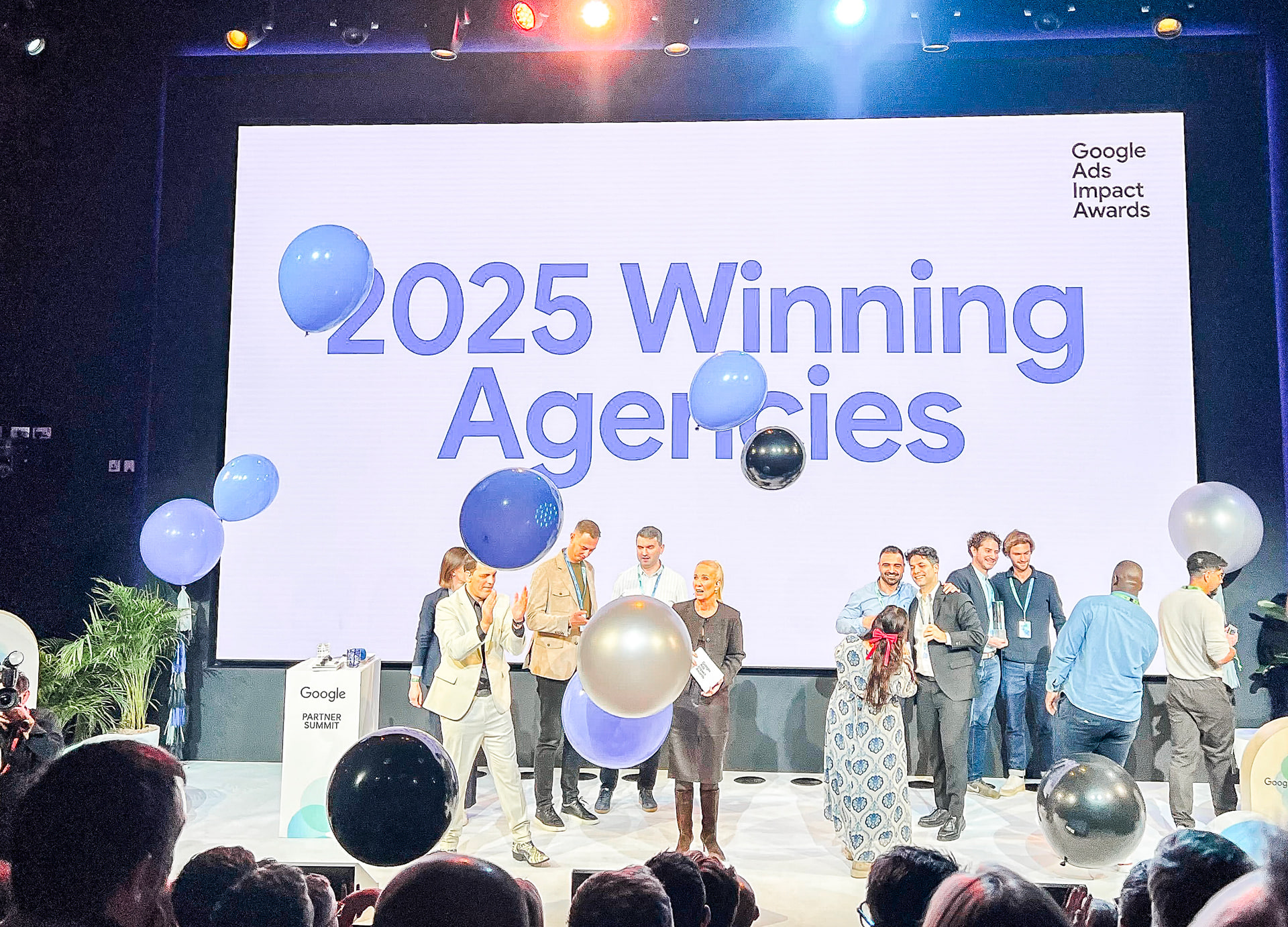
bright, google premier 2025
How Google is reinventing Search with artificial intelligence
Google is rolling out a series of new features that place AI at the heart of the user experience.
AI Overviews: AI-generated answers at the top of Search
AI Overviews offer an intelligent summary directly in the search results.
Since 2024, Google has also been testing advertising within them — a first. The ads appear in or around the AI answer block, which pushes brands to rethink their presence from the discovery phase onwards, and no longer only at conversion.
For now, these formats are live only in the United States and Asia (Singapore, India, Japan, Indonesia, Thailand, Vietnam, the Philippines).
In Europe, the rollout is expected over the coming quarters (Google Support, Campaign Asia).
What it changes for brands: they will have to learn to work on the relevance of the message from exploratory search onwards, in an environment where content and advertising blur together.
Google Lens: the visual as Search’s new language
With Google Lens, search becomes visual: photograph a product, a place or a scene and you get instant results.
Its use is exploding, notably among Gen Z, who favour immediate, intuitive experiences.
For brands, that imposes new best practice:
- Produce high-quality product visuals, distinctive and coherent.
- Secure precise classification (through the GTIN in particular).
- Follow visual performance, even if the reporting does not yet isolate Lens entirely.
At Bright we have already brought that logic into our campaigns: think image first, keyword second.
AI Mode: search becomes conversation
Google is trialling AI Mode, an interface where search takes the form of a continuing dialogue.
The user asks a question, then refines as the conversation goes on.
What that implies: advertising will no longer rest on the keyword alone, but on the context and the conversational intent.
Google is already testing formats able to appear within an AI answer itself, extending the link between discovery and conversion.
AI Max: automation at its height
The latest step: AI Max, a new generation of Search campaigns built on advanced machine learning.
It follows on from:
Smart Bidding → Broad Match → Performance Max → AI Max.
AI Max promises a finer understanding of intent, AI-assisted ad creation and dynamic targeting.
But it also marks a turning point: more control handed to the algorithm, less human intervention.
The bright method: keeping control in an AI-driven Search
At Bright we treat every Google Ads novelty as an opportunity to validate, not to submit to.
Our method rests on three simple principles: test, understand, frame.
- We set precise test protocols.
- We compare real performance.
- We measure the business impact before generalising anything.
AI speeds up change, but it does not replace analysis.
Our role is to keep a firm hand in an increasingly automated environment, and to make sure algorithmic decisions serve the strategy, not the other way round.
Conclusion: Search evolves, our standard stays the same
Tomorrow’s Search will be conversational, visual, AI-assisted.
Google intends to remain the central engine of this new era of the web.
For brands the challenge is twofold: adapting to these new habits while keeping control of their performance.
At Bright we help our clients meet that challenge every day: understand before adopting, measure before widening, and always steer with purpose.
Going further
- Search and Google Ads11 publications
- Awards5 publications
- Artificial intelligence8 publications
The key skills bright can bring to you