

Answer Engine Optimisation: being cited by LLMs
Louis Lapointe
· 17 min
Search marketing is not disappearing, it is changing shape: you now also have to appeal to the AIs that answer users directly. And in AEO, authority is no longer a competitive advantage — it is a prerequisite.
Swipe left to read
Keep reading
Search marketing is not disappearing, it is changing shape: you now also have to appeal to the AIs that answer users directly. And in AEO, authority is no longer a competitive advantage — it is a prerequisite.
Introduction.
The internet and our habits for consuming information are changing fast. You will surely have noticed, but since OpenAI arrived with ChatGPT, and its competitors with it, AI has been gaining ground little by little against “classic” search engines such as Google or Bing. According to a recent Ifop study (2024 barometer, “The French and generative AI”), more than 28% of digitally active Europeans now use a generative AI as their first point of entry when searching online (and that percentage even passes 50% on certain segments of the population). This shift marks the start of a new era, in which answer engines complement — and in some cases replace — traditional search engines.
Over recent months especially, we have seen a strong downward trend in CTR (click-through rate on the ad) on Google campaigns and in organic, and that across the board. The organic CTR of the first result on Google, for instance, has fallen by more than 10 points compared with the last three years, partly because of the AI Overviews (AIO) present on the results page (people speak of the “zero-click search” phenomenon, since nobody clicks on the results). Fewer clicks, more competition, and so a rising CPC. For advertisers, that is a signal that the strategy has to adapt.
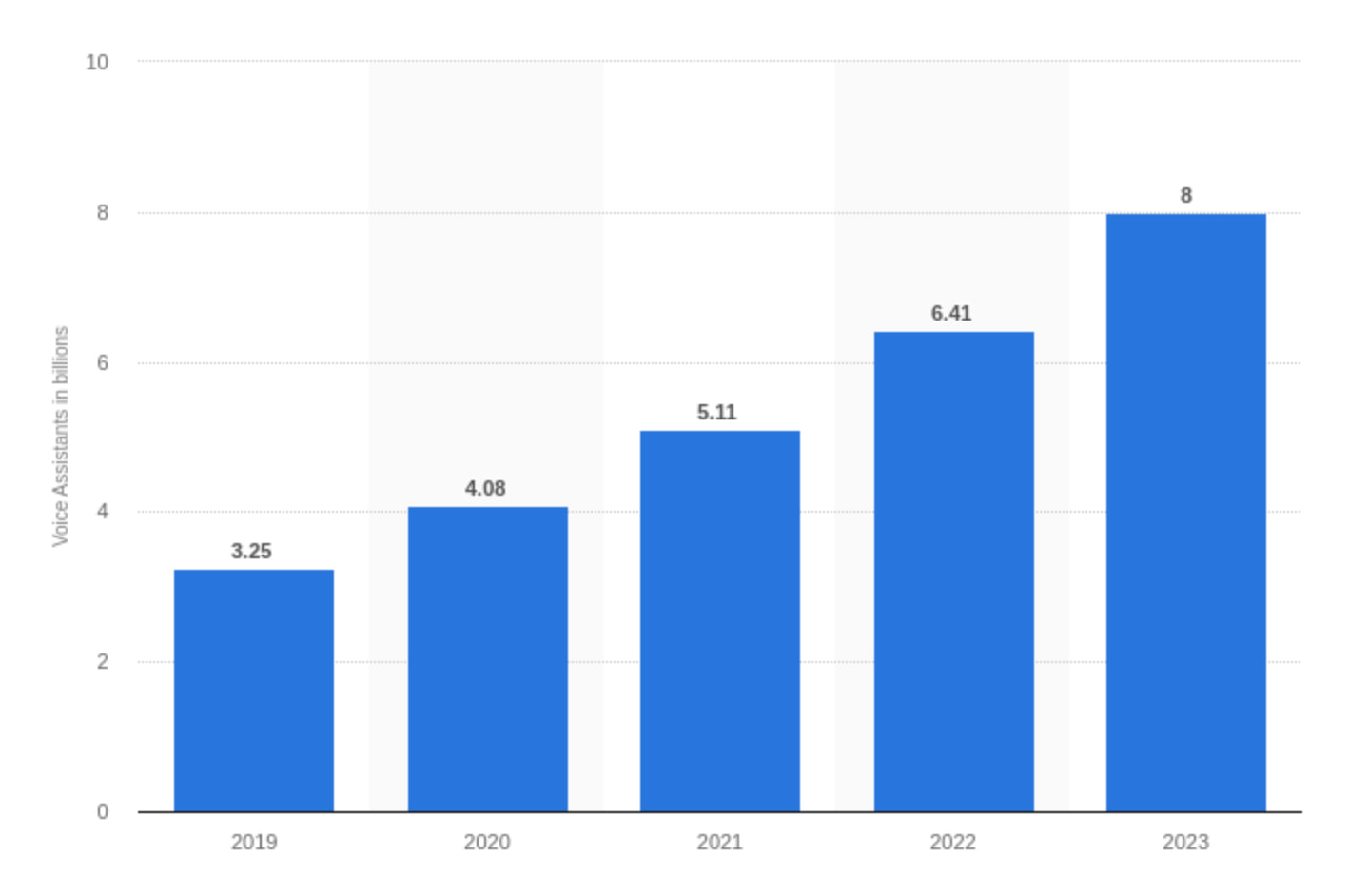
Voice assistants go from 3.25 to 8 billion between 2019 and 2023, about +25% a year
Number of voice assistants worldwide, in billions, from 2019 to 2023.
Source: Statista, 2019; values taken from the labels of the chart published in the article · Chart: bright.swiss
Source: Statista 2019
Another important trend to take into account in this change of user behaviour can be seen in the growth of devices with voice assistants (Alexa, Siri and the like). In 2023 there were no fewer than 8 billion of them. That figure only keeps rising, and it plays an important part in accelerating the phenomenon.
Answer Engine Optimisation (AEO) is slowly settling in as the natural extension of SEO — but instead of aiming to be placed first in the search results, here the aim is to be used by the AI as the answer to the user’s questions.
This shift does not affect organic traffic alone; it can also play a crucial part in your SEA performance. If more and more people talk directly to an AI rather than questioning Google and Bing, that is as many people who will never see your ads.
As things stand (editor’s note: January 2026), it is not yet possible to pay ChatGPT to sponsor content on the platform. It has been mentioned that certain “shopping” answers could contain affiliate links to OpenAI’s benefit, but for now, improving your visibility in the answers the AI gives depends solely on the quality and the authority of your organic content. AEO is therefore becoming an essential lever for staying visible in this new ecosystem.
Update, September 2026: it is now possible — ChatGPT Ads is open to Swiss advertisers, with ads kept separate from the model’s answers.
This article presents various essential technical optimisations as well as editorial best practices for maximising your chances of being cited, used or recommended by generative AIs such as ChatGPT, Claude or Gemini.
Source: Statcounter.
The article will often refer to ChatGPT for the sake of readability, but these recommendations apply to all of today’s main AIs.
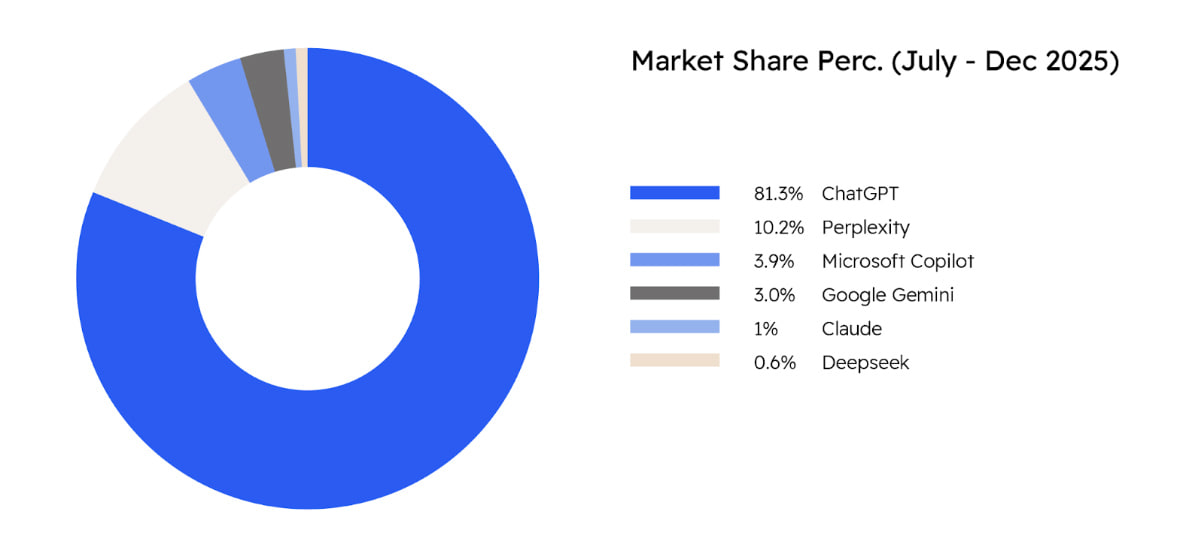
ChatGPT holds 81.3% of the conversational AI market, close to eight times Perplexity’s share
Market share of each conversational AI, in %, from July to December 2025. The original image says neither what is measured (visits, queries…) nor the scope.
Source: not stated on the image published in the article; values taken from its caption · Chart: bright.swiss
Adapting your site’s technical foundations.
A site’s technical side (its HTML, its structure, its semantic markup and so on) plays a central part in this process. In a way, SEO’s flagship principles are the basis for AEO today, and that for several reasons.
For an AI to be able to use your site, the site first has to be crawled and understood properly by the AI.
For most requests, ChatGPT does not surf the web in real time. It first searches the immense database it was trained on, before potentially completing its conclusions by going out to find more information on the net. It carries out that search through a crawler named GPTBot. So be careful not to block that bot through your robots.txt file, for instance.
Between the raw crawling of the site and the in-depth analysis of its content, there is one key asset today that remains genuinely under-exploited: the .txt files dedicated to LLMs. Just as robots.txt serves SEO, some websites now provide an llms.txt file designed specifically to guide conversational AIs in understanding their business, their services and their positioning.
That file is not meant to be indexed, but to provide clear, structured and unambiguous context on who you are, what you do, for whom, and in which situations your site is a relevant source.
At bright, for instance, we have put our own file in place, available here: bright.swiss/llms.txt
The prompt below generates an llms.txt file in line with AEO best practices, giving the language models the context they need to understand precisely the site’s positioning, its use cases and its relevance as a source of answers.
You are an AEO (Answer Engine Optimization) expert. Generate an "llms.txt" file (plain text) meant to help conversational AIs understand and correctly cite a company.

Constraints:
- Format: plain text, clear, structured with short headings.
- Tone: factual, precise, no marketing superlatives, no unverifiable promises.
- Length: 250 to 600 words.
- Language: English (add an "FR summary" section of 5 to 8 lines if the company is bilingual).
- Include: the company's identity, services, audiences, geographic areas, differentiation, topics covered, topics not covered, pages to favour (URLs), pages to avoid (URLs if useful), contact information, and the date of the last update.
- Add a "Preferred citations" section listing 5 to 10 URLs of the site to cite first (services, case studies, resources, contact).
- Add a "Brand & naming" section with the brand's exact spelling and the acceptable variations.
- End with "Last updated: YYYY-MM-DD".

Company information:
- Name:
- Country / areas:
- Positioning:
- Services:
- Audiences:
- Sectors:
- Key pages (list of URLs):
- Pages to avoid (list of URLs):
- Contact:
- Languages:
- Proof points (certifications, years of experience, etc.):

Expected output:
- A single block of text: the complete contents of the llms.txt, ready to publish at the root of the site (/llms.txt).
It is also worth noting that ChatGPT uses the Bing search engine to reach this information. If your site is not properly indexed on that search engine, your chances of appearing in an answer are practically nil. So it is essential to check your indexation on Bing Webmaster Tools regularly (on top of the one on Google).
Once it is accessible, make sure its technical structure makes your content easy to read automatically.
Make sure your HTML is clean and properly hierarchical. Use a heading structure (H1 for the main title, H2 for sections, H3 for sub-sections and so on) so that the level of information is clearly understandable. AIs use that markup to understand better which parts are the most relevant.
Using HTML5 semantic elements (‘article’, ‘section’, ‘header’, ‘footer’ and the like) is also strongly recommended, since they clearly signal how your content is organised, which helps these algorithms interpret it more easily. Beyond the HTML structure, let us not forget the metadata. Use relevant meta descriptions for each of your pages and fill in descriptive alt text for your images. That way even multimedia or visual content can be used by text-based AIs, which can only “read” text.
Just as important: optimise your site’s navigation.
A clear and logical architecture (a well-structured menu with few sub-menus, for instance) makes crawling a million times simpler for the AI — and for your users, incidentally. The same goes for your URLs: making them descriptive is a great help (e.g. bright.swiss/what-we-do/social/).
Internally too, try to optimise your link structure. Connect your pages to one another coherently. Good internal linking lets AIs understand the semantic relationship between different pages more effectively, and it raises the probability of being recommended during a chat.
One last important structural detail: implement structured data (Schema.org)
Semantic markup through Schema.org has become essential for giving algorithms an explicit way of understanding the nature of each piece of content. The schema specific to FAQ pages, for instance, is used particularly often, given that it is a section AI agents frequently exploit in their search for answers. Consider these schemas too: Article / HowTo (for step-by-step tutorials) / Product / Organization or LocalBusiness.
The structural side of the site is therefore a fundamental basis for AI search marketing (also sometimes called Artificial Intelligence Optimization (AIO) or Generative Engine Optimization (GEO)). It creates favourable conditions to encourage crawlers such as GPTBot to search, but that is only part of the work. Now you have to create content the AI will want to use.
Another structural element that is often underestimated: the XML sitemap. Where it is still too often seen as a “classic” SEO tool, the sitemap also plays a crucial part in AEO. It lets search engines — and, indirectly, the AIs that depend on them — quickly identify which pages exist, which are priorities and how the site is structured.
A good sitemap is not a mere list of URLs; it reflects a clear hierarchy of the content and distinguishes the strategic pages (services, expertise, pillar content) from secondary content, which makes discovering new pages much simpler.
At bright, our sitemap is structured as a sitemap index (bright.swiss/sitemap-index.xml) which clearly separates the different kinds of content (pages, articles and so on). That approach improves how the site reads as a whole for crawlers and strengthens the coherence between the technical structure, the content and the positioning.
Creating content for the AI (and for your users)
Once your foundations are solidly consolidated, we can start talking about content.
The ultimate objective of any text-based AI such as ChatGPT or Claude is to provide the most relevant answer to the user. Your mission is therefore to produce content that answers your audience’s questions accurately, clearly and concisely.
ChatGPT has a quite simply massive corpus and “understands” more and more of the real intent behind each user request. So it is essential to create pages with rich, well-structured educational content that gives a genuine answer to your audience’s question.
Here are a few best practices for raising your chances of being recommended by an AI:
- Anticipate your audience’s questions and answer them directly. Identify the frequent or implicit questions your prospects might have and include them as they are on your pages (as headings or as an explicit question). Then give the answer immediately after. For instance, if you know your prospects wonder “How do you choose accounting software?” when they are in the consideration phase, create a heading with exactly that question and give a precise answer directly after it.
- Structure your writing for readability. Your headings should be clear and descriptive (forget anything vague or too marketing), keep your paragraphs short (three or four sentences at most), and do not hesitate to use bullet points or tables to break up the information. For instance, instead of writing “6 tips for raising your CTR”, write “How do you raise your CTR?”, because that variant states the question asked plainly. Do not hesitate either to add a FAQ section at the end of your page to address the secondary questions.
- Rest on facts and sources. Even leaving AI aside, reading a text full of statistics without a single source does not inspire confidence; the same goes for ChatGPT. If, for instance, you announce that you got your client a platform ROAS above 10, add a source. These factual elements can be incorporated into the AI’s answer, and your page may even be cited as a direct source if it is considered reliable enough. On top of that, these elements also contribute to your E-E-A-T, which improves your authority (see the next section).
- Favour originality over quantity. AIs value content with high added value. An article that goes deep, with an expert view and new insights, has far more chance of being used than recycled or superficial “evergreen” content. Avoid generic or copy-pasted content and adopt a specialist’s tone instead, to go further into your expertise. For instance, when you list a solution’s pros and cons, give concrete examples drawn from your own experience. It is that level of context and depth which can set your content apart from the base the AI was trained on.
- Note too that, unlike in SEO, there is no need — it is even counterproductive — to try to over-optimise certain keywords by mentioning them repetitively and forcedly. Crawlers such as GPTBot understand the subject through context, so keep your text reasonably dense and your semantic field varied.
The clearer, more organised, more useful and more reliable your content, the easier it will be for AIs to extract relevant answers from it. Keep in mind that your content addresses your audience as much as the AIs: everything that helps a human (logical structure, direct explanations, simple language) also helps ChatGPT.
One common question keeps coming up: is content generated with tools like ChatGPT indexable and relevant for SEO? The answer is clear: yes, provided it meets the same standards as any other content.
Search engines (and conversational AIs) do not judge content on how it was written, but on the real value it brings the user. AI-generated content that has been reviewed, corrected, enriched by human expertise and shaped around a specific audience can perfectly well be indexed, rank well, and even be cited as a source by the AI.
Conversely, content generated automatically without any supervision, generic or designed solely to create volume, offers little value — whether it was written by a human or by ChatGPT.
It matters to keep in mind that in AEO, AI should become a support tool for creating content, not a replacement for strategic thinking. The best-performing content is where AI speeds up the writing while human expertise guarantees the relevance, the reliability and the added value.
Even with excellent content, your site will only be put forward if it is considered a reliable source with a certain authority in its field. AI engines (just like Google) attach a lot of importance to certain trust signals, and that is where the concept of E-E-A-T (Experience, Expertise, Authority, Trustworthiness) makes full sense. Google defines certain criteria for assessing a page’s quality, and those are just as important for AIs when they decide whether your site is worth citing.
- Show your articles’ authors and their qualifications clearly. Name, photo, role in the company, years of experience, relevant degree or certification. All these details amount to a solid level of transparency and a strong signal of expertise. In practice, add an “about the author” section (even a brief one), or something similar, to each contribution, and do not hesitate to link their LinkedIn account or their earlier articles.
- Put your client testimonials and case studies forward. Real feedback from satisfied clients strengthens your credibility (and, once again, that holds for your prospects as much as for the AIs). Pages that include authentic testimonials or concrete client cases receive significantly more recognition in AI-generated answers.
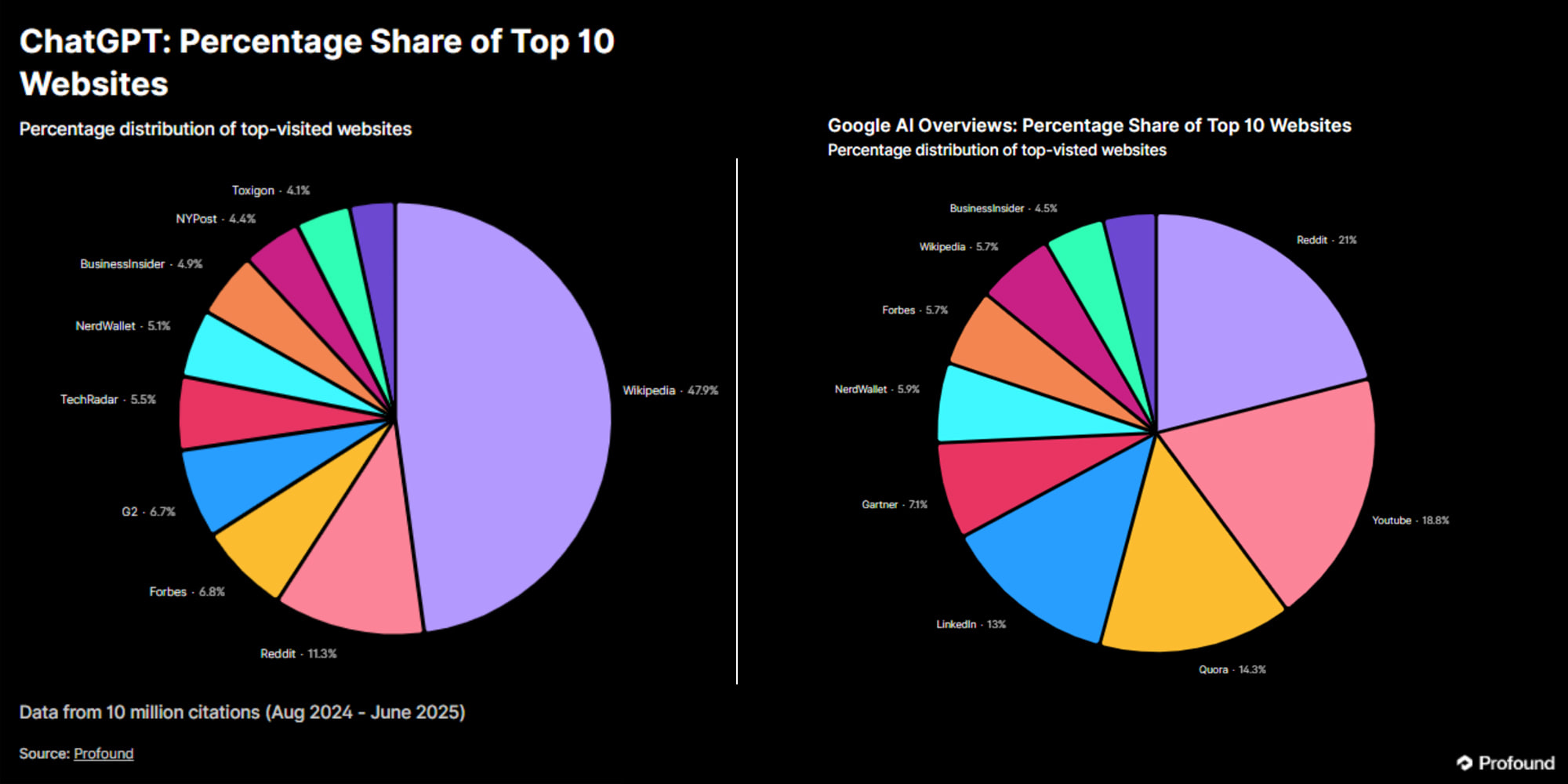
- Earn mentions on high-authority sites. Beyond your own site, your online reputation is also built around what other sites say about you. According to a study carried out by Profound on more than 10 million queries in 2025, close to half of the sources come from Wikipedia. On Google’s AI Overviews it is Reddit that leads (which is consistent with the platform’s Q&A format). Granted, not everyone can have a Wikipedia page, but an SME can aim to be covered in the specialist press, through an interview, or even on recognised sites.
Wikipedia makes up 47.9% of the citations in ChatGPT’s top 10, against 5.7% in Google’s AI Overviews
Each site’s share of the citations of the ten most cited sites for each engine, in %, over 10 million citations, from August 2024 to June 2025.
Source: Profound, 10 million citations, August 2024 to June 2025; values taken from the labels of its two charts · Chart: bright.swiss
Even without a link back to your site, a mention of your brand can already make the difference and weigh in the AEO balance.
- Encourage client feedback and manage your online reputation actively. Three quarters of users regularly read reviews before choosing a company or a product, and a bad reputation can drive away as much as 30% of potential customers. Generative AIs love the natural and (mostly) honest language found in customer reviews. So encourage your satisfied clients to leave detailed reviews on Google, Trustpilot and the like. Monitor and actively manage your reputation by answering comments, correcting any erroneous information that might be circulating, and showing your brand in its best light.
- Put your certifications, labels and awards forward. Any official recognition of your expertise is a far from negligible bonus. Take bright as an example: our agency has been certified Google Premier Partner for several years now, and holds the equivalent on the SMA platforms. By putting that forward on our site, Google attests to our expertise both to potential clients and to the AIs. If your badge is a little less widely recognised, do not hesitate to spell out what it represents, so as to raise its standing.
By strengthening your E-E-A-T this way, you send the right signals to Google, to the AIs and to your prospects at the same time. You show that your site is run by experts, appreciated by its clients and recognised in your industry’s ecosystem. Claude and ChatGPT will, by their very design, be drawn first to the kind of sources they consider important.
SEA vs. AEO: rethinking your marketing strategy
Finally, it matters to address the subject of paid in this new context. Historically, SEA has always let companies acquire immediate visibility by placing them at the top of the Google or Bing results, in exchange for a more or less competitive sum. If users now shift and turn more and more to ChatGPT to answer their questions, they end up bypassing sponsored content entirely.
Every AI query is, in a sense, one search (or even several) fewer on traditional search engines, and so one click fewer for your Search campaigns. Should we fear the imminent end of SEA? Not necessarily, but it matters to adapt our approach and to keep up with the frantic pace OpenAI and its competitors set today.
First, we have to accept that classic SEA’s reach has shrunk, and will keep shrinking, on more informational queries in favour of AI answers. If the objective is still to be at the top of the page, having the biggest paid budget is no longer enough: you have to be able to invest in your organic AEO presence to compensate.
Next, it matters to keep in mind that the providers of AI solutions are in constant flux, so it is essential to set up a routine of watching reliable sites. Here is a list of the ones we use ourselves:
- ChatGPT News (the official releases from the market leader)
- Claude Support (the equivalent at Anthropic)
- Google Blog (the equivalent for Gemini)
- The Batch (a high-quality newsletter, quick to read)
- Ben’s Bites (another newsletter, high-quality plain-language explanation)
ChatGPT recently launched its Shopping Research tool, which lets users search for the best product for their need — and it is only a matter of time before the platform lets us sponsor answers. OpenAI does, after all, have to develop profitable business models in order to move past the start-up stage.
Monetising their audiences looks like the logical next step, and the recent hiring of former Meta engineers suggests it will come soon. Keep up to date, or call on agencies like bright, which blend expertise and experience so as to stay in the front rank of this kind of marketing innovation.
To prepare as well as possible, here are a few pieces of advice we have begun applying at bright:
- Adapt the style of your ads. If you have campaigns running on Google Ads at the moment, consider rewriting your headlines and descriptions in more natural language. For instance, instead of a purely promotional headline such as “Solution X – 30% off”, choose something that addresses a need, such as “Save on tax with X”.
- Create “conversational” landing pages. Rework your landing pages so that they give users complete answers. With some of today’s tools, such as AI Max, the platforms already tend to draw on your sites’ copy to enrich your ads. So it is essential to optimise them to answer users’ queries as fully as possible. For instance, instead of creating a minimalist product page, add a FAQ, a competitive comparison (or an internal one against another version of your product), or usage advice.
- Optimise your shopping feed data for AI. If you run e-commerce ads (Google Shopping and the like), pay close attention to the data you put in your catalogues (titles, descriptions, attributes). These are the elements ChatGPT will pick up in its Shopping Research, and which are likely to improve your ads’ quality score if a similar system is put in place in AEA (Answer Engine Advertising). A product with a complete page, well-filled attributes, user reviews and relevant images (on a white background, ideally) will stand a better chance of being recommended by the AIs.
- Keep an eye on your costs and your KPIs. One of the biggest challenges we currently face is determining the “traffic” these AIs generate (because of the “zero-click search” phenomenon mentioned at the start of the article). We already use certain tools that let us analyse the impact of Google’s AI Overviews on our clients’ sites, but that does not cover the whole of this question. While waiting for more advanced first- or third-party tools, you can nevertheless run simple manual tests, by asking ChatGPT questions about your sector and seeing whether you appear in the results. As for the KPIs, it is clear that your traffic (organic or paid) will be affected by this revolution, which is why it matters to review your success indicators and adapt them to this new era.
SEO and SEA are not dead because of AI; they are evolving with it. Knowing how to combine your expertise in Search, content writing and data analysis is what will make the difference in your brand’s success. For agile advertisers, this aspect of artificial intelligence is an opportunity to capture extremely qualified traffic in creative and innovative ways. The best approach is therefore to embrace the change, to keep exploiting the traditional levers while investing in these new AI-centred practices.
Conclusion
The rise of ChatGPT, Claude and every other conversational AI is a major turning point in how brands are seen on the internet. Search habits are changing and your digital strategy has to change with them. For your site to be recommended by these AIs, it has to be designed with both the human and the LLM in mind.
Concretely, that calls for solid technical foundations (well-structured HTML and data, indexation on Bing and so on), high-quality content (useful, structured and with plenty of added value) and strong brand credibility online (E-E-A-T, client reviews, external mentions and so on).
One point does deserve particular attention, though: the site’s authority becomes an even more decisive criterion in AEO than in SEO. Where classic search marketing could sometimes be “won” through solid technical optimisation or an effective keyword strategy, conversational AIs rest mainly on sources they perceive as expert, trustworthy and legitimate.
An AI is not just looking for a well-optimised page; it wants a credible source to lean on in formulating its answer — and in an age of disinformation, that logic is vital. It places the brand’s overall reputation, the clarity of its positioning, the identification of its authors, the proofs of expertise and the external trust signals at the heart of future visibility. In AEO, authority is no longer a competitive advantage: it is a prerequisite.
As for traditional search marketing, it is not disappearing, it is changing shape. Where yesterday you had to “please” Google’s algorithm to appear at the top of the page, today you also have to appeal to the AIs that answer users directly. In practice, that takes the form of content that is attractive and can be understood by these answer engines, so that they fold you straight into their summaries.
And the benefit in all this? Being as close as possible to your audience’s question at the moment they finally express their need, with no friction. We are watching a new acquisition channel come into being in its own right.
Going further
- Artificial intelligence8 publications


The key skills bright can bring to you