
DEX26: media and platforms facing AI
Andréa Schollhammer Escribano
· 7 min
Media groups, sales houses, agencies, Google and OpenAI: at DEX26, the whole Swiss media ecosystem was gathered in Zurich. One subject ran through almost every talk: how to stay visible and effective when AI is redrawing the way we inform ourselves and buy.
Swipe left to read
Keep reading
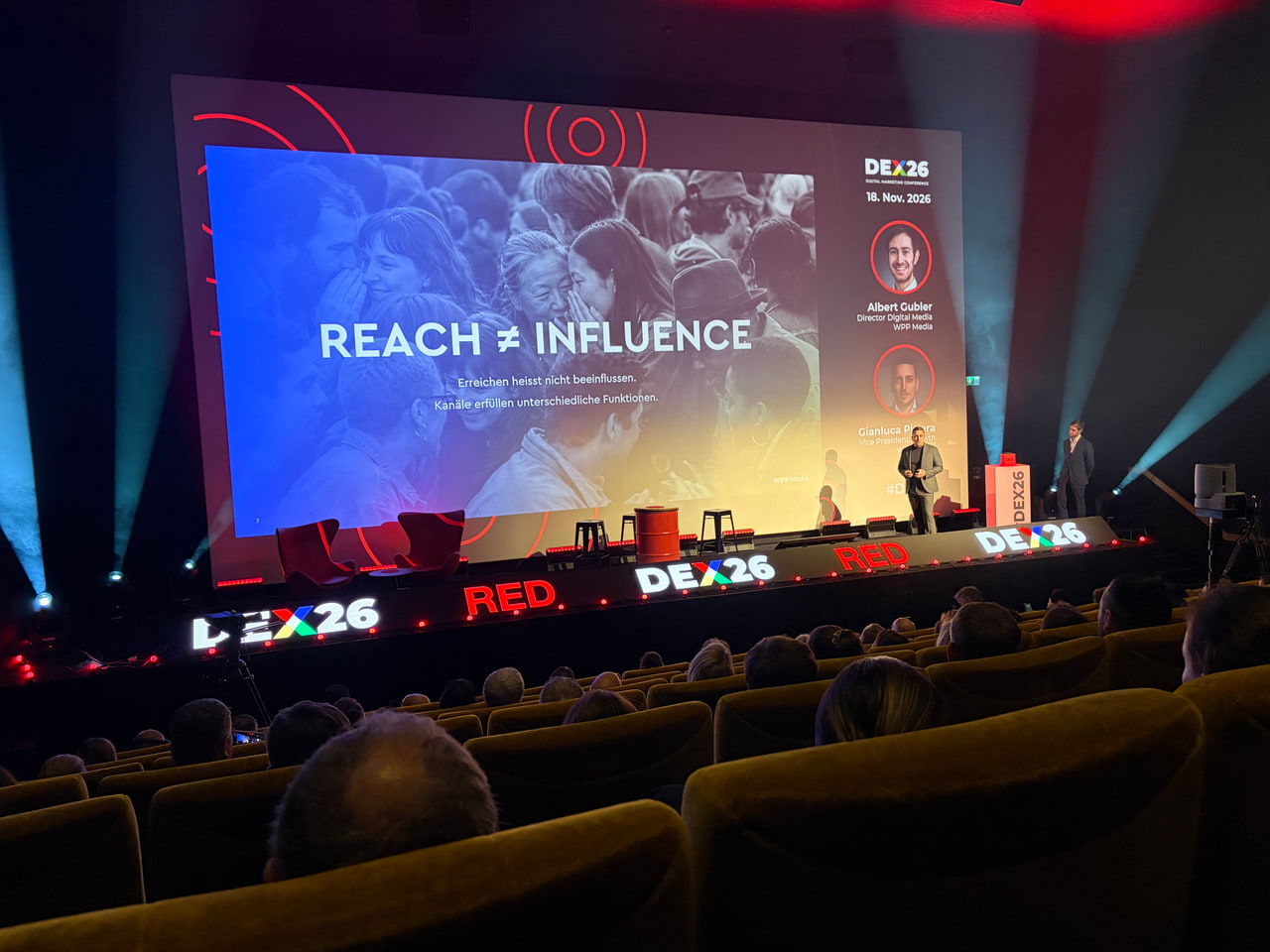
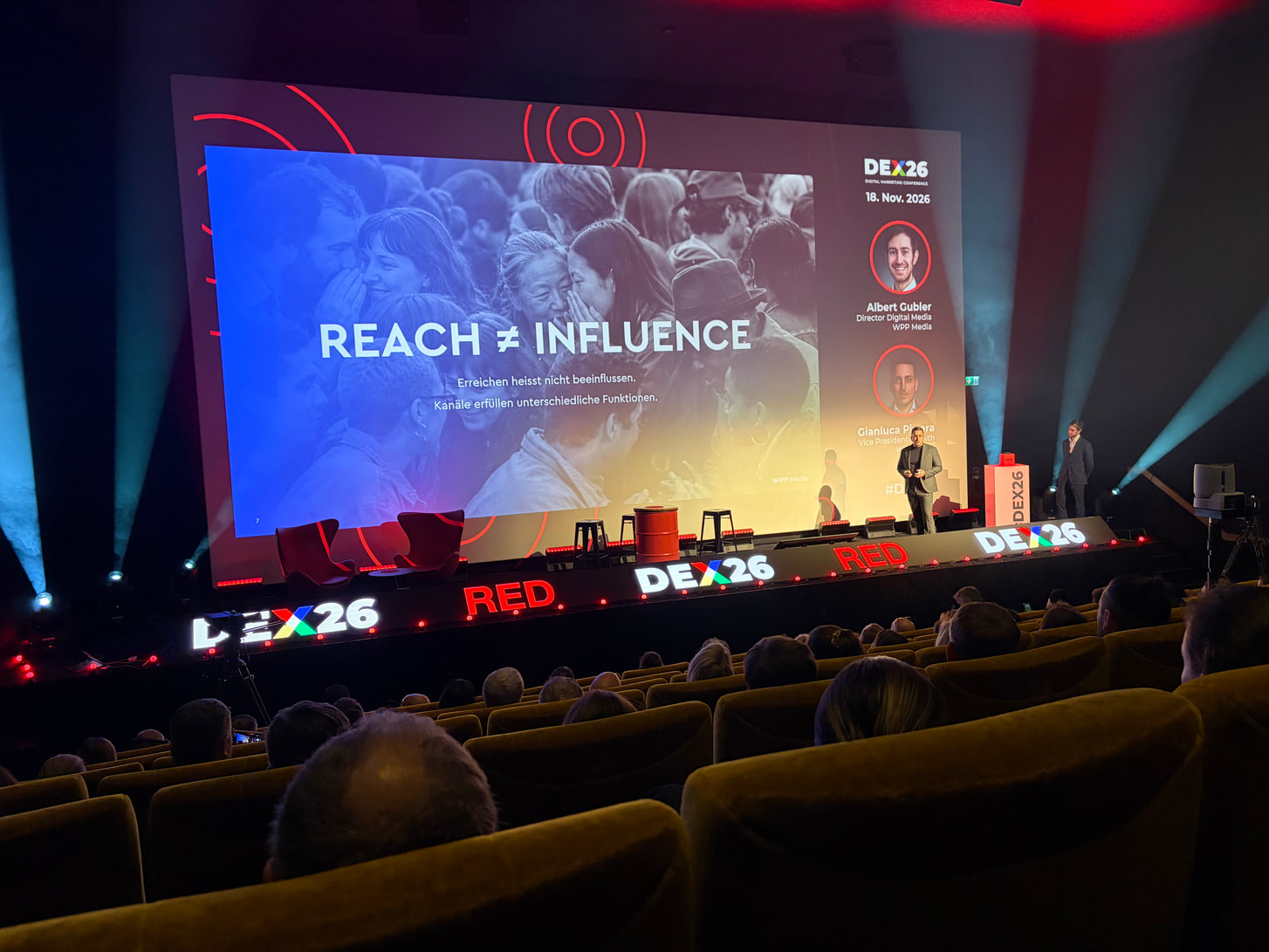
On Wednesday 18 November we had the good fortune to be invited to DEX26. Organised by IAB Switzerland at the KINOKONI, DEX is the meeting point of the media industry in Switzerland: one day, 66 sessions, 90 speakers.
The whole ecosystem was there. Media groups and sales houses, with Ringier, Goldbach and Audienzz as presenting partners, but also 20 Minutes, CH Media, Watson, Post Advertising and Zattoo. The industry associations, with IAB Switzerland, IAB Europe and the IAB Tech Lab. And the advertising platforms, with much awaited appearances by Google and OpenAI.
The subjects were varied, from CTV to advertiser cases such as Bayer on picking the right YouTube moments for its Supradyn brand. But one theme came back in almost every presentation: artificial intelligence, and the way it is reshaping every link in the chain.
The starting point: a journey that keeps getting messier
Everything starts from an observation the speakers shared: the way we consume information and media has changed deeply.
Between the moment a need appears and the moment we act on it lies what Google calls the messy middle. It is a zone of exploration and evaluation, made of constant back and forth between search engines, social networks, videos, reviews, media and brand sites. The journey is anything but linear: we search, we compare, we backtrack, we change our minds.
LLMs such as ChatGPT are now fully part of that zone. We ask them for a summary, a comparison, a recommendation. Some of the answers we used to look for on media or brand sites now arrive straight in the interface.
Two questions therefore ran through the day. How do the media keep existing in the middle of that messy middle? And how do advertisers and agencies make sure their advertising stays effective when the journey fragments this much?
Media: existing in the middle of the messy middle
For publishers, the question is fundamental: how do you keep creating value when information becomes ever more available and instant?
The talk by 20 Minutes offered an interesting answer. The outlet no longer settles for being a digital player. It adapts, offers new places to meet its readers and puts people back at the centre. Journalism remains the heart of what it does: the ground work, the fact-checking and an original take on the news, which an AI model cannot produce on its own.
That stance illustrates a broader trend. When generic information becomes available everywhere, credibility, exclusivity and closeness to the audience become the real points of difference.
The shift also touches the way content is served. For a long time the digital experience rested on standardised interfaces: websites, apps, news feeds, video players. AI opens the way to more personalised, conversational experiences that answer a precise need rather than pushing a stream.
For media groups and sales houses such as Ringier, Goldbach and Audienzz, the questions are very concrete. How do you keep a direct relationship with the audience when part of the discovery happens elsewhere? How do you give it a reason to come back? And how do you evolve the business models that fund content production?
AI does not replace what the media do best. It forces them to define their singularity more sharply, and to build an experience worth coming for.
Google and OpenAI: advertising moves closer to the purchase
This was, for us, the high point of the day. The Google and OpenAI talks brought out one and the same trend: the platforms are working to cut the steps between discovering a product and buying it, right in the middle of the messy middle.
Google: an ever more integrated Shopping experience
Google is evolving its Shopping experiences to simplify the path to purchase. Someone who discovers a product in an ad can look straight at its specifications, explore the offers available and, in some experiences, complete the purchase without leaving the environment they are in.
With product catalogue integration and the new AI-powered experiences, the lines between search, discovery and purchase are blurring. Some of these changes are still in testing or in gradual rollout, but the direction is clear: reduce friction and bring buying intent closer to the transaction. We already analysed that shift in our article Google showed us the future of Search.
ChatGPT: ads that become genuine experiences
At OpenAI, the outlook presented points towards richer ad formats built into conversations.
The travel and hospitality example illustrates it well. Rather than a classic ad, the user discovers offers directly inside ChatGPT, with an interface built to show the specifications and the information useful to the decision. Advertising no longer stops at sending people to an external site: it becomes a step in discovery and comparison.
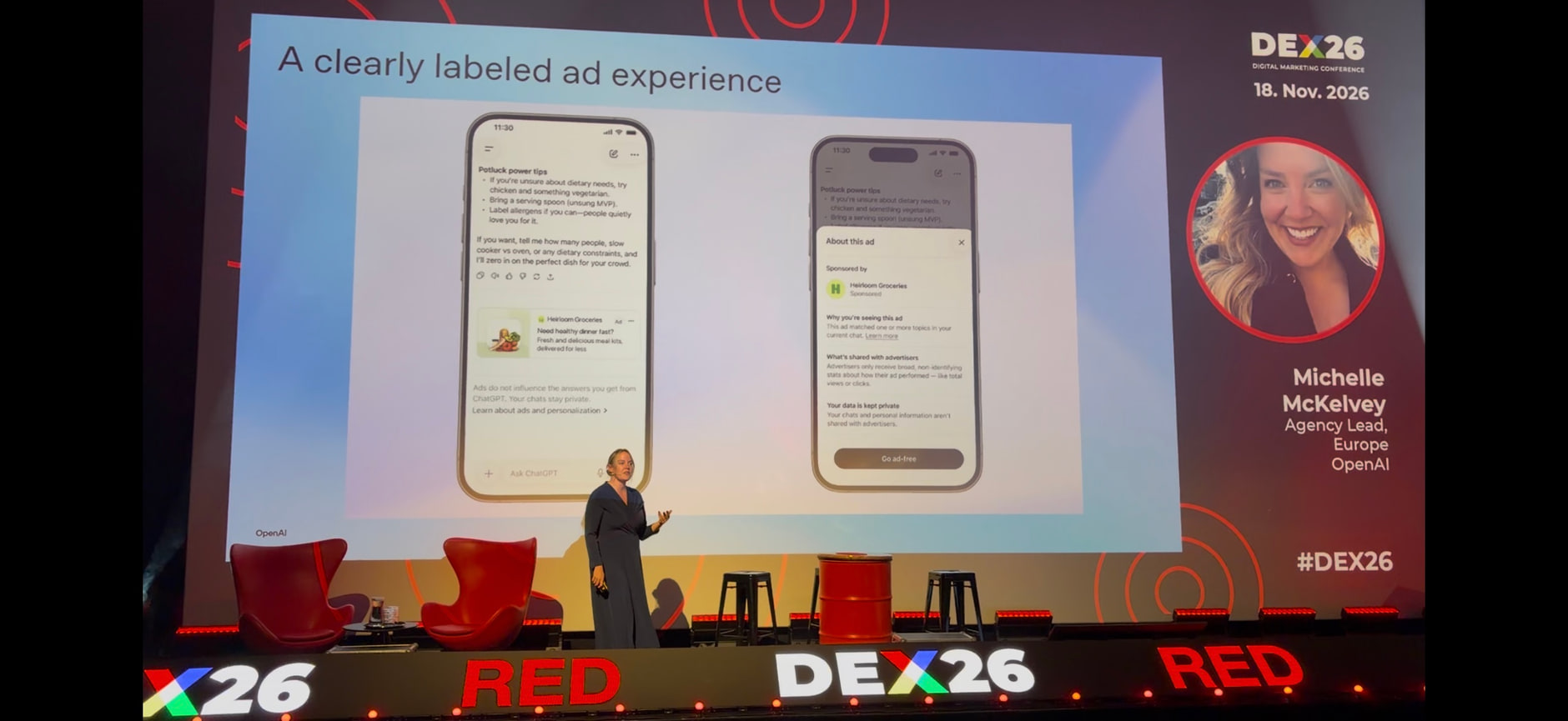
And it is all moving fast. As the OpenAI speaker underlined, the platform’s features keep evolving, with new experiments and announcements on a regular basis. We covered the first formats in our article on ChatGPT Ads arriving in Switzerland.
We are moving from advertising that tries to capture attention to advertising that accompanies the user’s intent.
And for advertisers, what does it change?
Historically, digital campaigns were there to drive traffic to a site, where the conversion happened. If a growing share of decisions, and even of purchases, happens inside the platforms themselves, one question follows: what becomes of the customer journey when the user no longer needs to visit the brand’s site to buy?
That question raises others, still largely open: how do you attribute a sale that closes on a platform, what customer data will the advertiser have access to, how do you build a lasting relationship outside your own ecosystem, and what role will the website play tomorrow. At the speed these experiences are rolling out, those are matters for the coming months, not for several years out.
We take away three areas of work for brands.
Be visible where decisions are made
Search engines, social networks and the media are no longer the only points of discovery. Conversational interfaces add themselves to the messy middle, and the existing platforms are folding comparison and purchase into their own. Brands have to understand how their customers move between these environments, answers from AI included: that is the whole point of Answer Engine Optimisation.
Visibility is no longer about driving traffic to your site, but about being present and relevant at the moment of choice.
Invest in creative, and dare to test
A creative built for a social network does not meet the same expectations as an ad built into a conversation, a Shopping experience, an editorial environment or a CTV screen. Every environment calls for its own format.
That is where to push. In a journey this fragmented, the visual and the creative are what makes the difference, and they deserve real investment. Being inventive matters: testing new angles, new creatives, new mechanics, and learning fast from what works. We see it already on Meta, where creativity has become a performance lever in its own right. At bright, our creative department supports brands through exactly these tests, from the concept to the version each environment needs.
Rethink performance measurement
This is probably the biggest challenge. If some transactions happen without ever passing through the advertiser’s site, traffic will no longer be enough to understand what each lever contributes.
Robust tracking is no longer optional. Server side becomes a requirement, and it will take real investment: time, skills and budget to build a reliable measurement infrastructure that does not depend on platform reporting alone.
Data remains the arbiter. It is reliable data that lets you measure what works, what does not, and make the right calls.
What we take away from DEX26
Let us be honest: that AI is everywhere is hardly a discovery. What DEX26 showed is that it has become the industry’s news in itself, and that everyone is adapting. Media, sales houses, agencies, platforms: each one is testing, launching, adjusting.
Plenty of new things have already shipped, others are in testing, and many more are coming. And it is all moving fast. We are planning 2027 right now, yet some of the changes that will mark the year are not known yet. We will have to take them on board along the way.
There are a lot of good things ahead of us.
At bright, our conviction stays the same: the point is not to adopt every new thing, but to understand how these shifts can create value, improve experiences and deliver concrete results.
Going further
- Artificial intelligence9 publications
- Media and programmatic7 publications
- Search and Google Ads13 publications
The key skills bright can bring to you