


Choosing your DSP for programmatic
Vincent Prou
· 5 min
Generalist, specialist or walled garden: the choice of a DSP depends on the objectives, the inventories and the transparency. With a minimum often set at USD 50,000 a month, few advertisers open a licence directly.
Swipe left to read
Keep reading
Generalist, specialist or walled garden: the choice of a DSP depends on the objectives, the inventories and the transparency. With a minimum often set at USD 50,000 a month, few advertisers open a licence directly.
In the advertising landscape, display, video and native are important levers in a media mix, for growing a brand’s performance and its recognition.
It is therefore necessary to have the best technology solutions for making the most of those channels. To that end, the market has organised itself over the last ten years around solutions we call Demand Side Platforms (DSPs). Those platforms are meant to be gateways to the various formats, media and data available for running relevant advertising campaigns. There are, however, a number of platforms, and understanding their benefits is what tells you which solution fits.
First, to define what a DSP is, it is essential to be familiar with the concept of programmatic advertising.
Generally bought and sold through auctions, programmatic lets advertisers deliver ads targeted by various criteria on websites and mobile apps.
Now to what a DSP is. A Demand Side Platform is an online advertising system — a platform — that uses algorithms to let advertisers buy programmatic advertising from one central place. It uses algorithms to target users against their data, so as to get the most out of the campaigns.
The aim is to get the most out of advertising campaigns, by finding the impressions that pay the buyer best.
DSPs therefore give access to the advertising supply coming from one or several online marketplaces, where supply and demand meet. There are a great many DSPs, from specialist technologies such as Xandr or DV360, to the meta consoles that include the advertising inventories of Facebook, Instagram and other apps.
It is therefore very hard for newcomers to find their way through that jungle.
To see more clearly, the first step is to sort them into segments:
What kinds of DSP are there?
Generalist: these DSPs often aim to cover every display format, by way of video, native, DOOH, connected TV and so on
Among the generalist DSPs:
DV360 (Google): Google’s solution, which benefits from Google data in addition
Xandr (Microsoft), formerly AppNexus: the most appreciated solution in adtech, because it is completely open and allows interoperability and the integration of advanced technology layers. It is also an SSP.
Mediamath: a DSP devoted to advertisers and particularly appreciated by the agencies that use it to trade their campaigns.
Adform: a European company — less common in this industry — offering a complete solution for running programmatic campaigns
And many others.
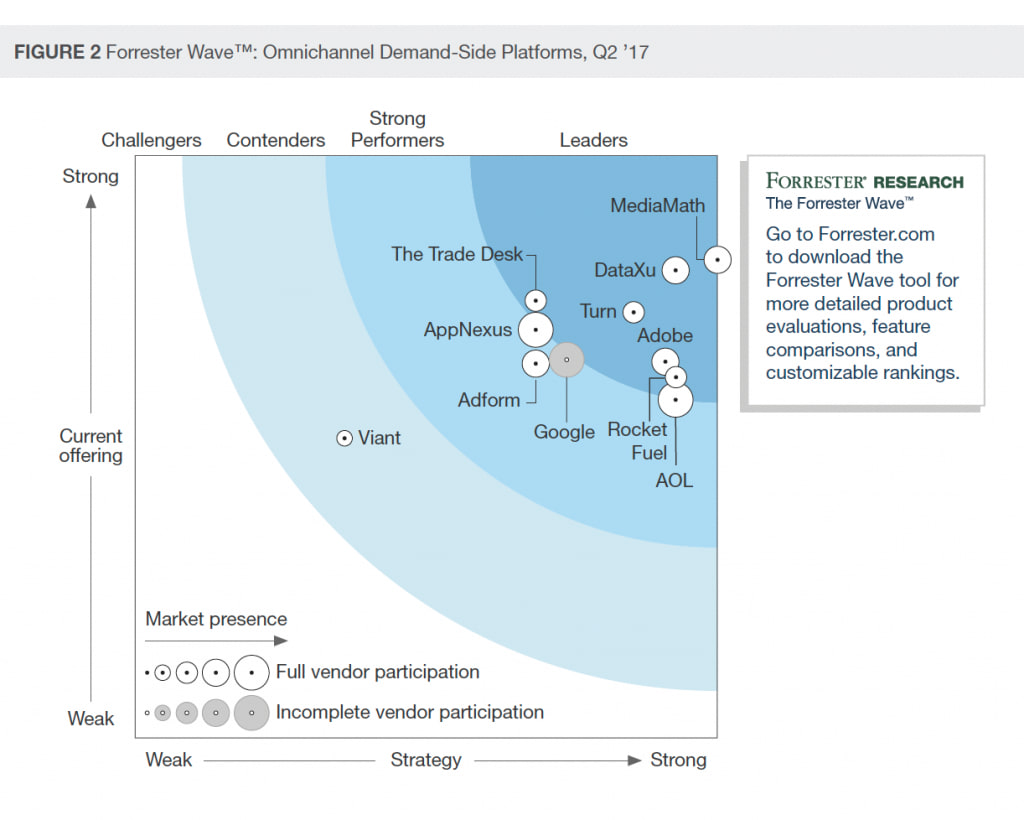
Source: Forrester Wave™, Omnichannel Demand-Side Platforms.
Specialist: these DSPs stand apart through their technological capabilities on certain formats, screens or technologies.
-
Format
- Zemanta for native: this solution specialises in the native format and lets you reach a great many networks from a single platform, with centralised tracking and CPC buying
- DSP+ for pop-under: there are also DSPs specialising in formats and inventories found on no other platform. That is the case of DSP+, which lets you buy a format sought by a certain category of advertiser.
- There are DSPs specialising in web or app push notifications, for instance, or in in-read video, podcasts or digital radio.
-
Technology or screens
- Hawk for mobile: this solution is particularly advanced for running mobile campaigns, with advanced mobile formats built in
- Displayce for DOOH: this solution is 100% devoted to DOOH (digital out of home), and offers solutions fitted to booking and running that kind of campaign. It is more relevant to run your DOOH from Displayce than from a generalist DSP.
- There are DSPs that specialise in connected televisions, or in television over the internet through streaming, which reaches people in audiovisual consumption that diverges from traditional television.
Walled garden: these DSPs were designed by their owner to oblige advertisers to go through their own buying platform, so as to control how the advertiser delivers, and above all to keep a hand on the data.
- Google Ads: is a form of DSP, since you can buy video, display and native advertising inventory — is search not native search? — with the strength of Google’s proprietary data.
- Meta business manager: also a very good example of a walled garden, since you can buy on Facebook, Instagram, and on all Meta’s other partner apps, with the full power of Meta’s data and algorithms. It is a solution much favoured by social enthusiasts, because it is open to all with no minimum. There are several alternatives, however, such as the other social platforms — TikTok or Snapchat — which each have their own walled garden solution.
- Amazon DSP: Amazon owning a large share of the world’s e-commerce data (outside China) through its marketplaces, the brand with the smile developed its own programmatic buying solution, which lets you buy native placements in Amazon to promote products in its marketplaces, but also on other sites and publishers Amazon owns (Twitch, IMDB and so on), not counting its exclusive partner network.
- Yahoo DSP: also offers a buying solution with its proprietary data, including search data from the Yahoo engine, across display, video and above all native, which perform well through the quality of its placements and through certain strong Yahoo audiences, such as finance.
- DV360 for YouTube (even though Google has been found to have abused its position and must open that inventory to other DSPs): DV360, a generalist DSP, is also a walled garden for Google, because it is the only DSP that allows video buying on YouTube. That will have to change under pressure from the antitrust regulators.

Why choose one DSP over another? Several criteria can influence your choice, notably:
- The client’s objectives and the strategy that follows from them
- The ability to reach specific inventories, such as YouTube through DV360, Twitch and Amazon with Amazon DSP, or Facebook and Instagram with Meta business manager
- The synergy with the various platforms, such as the Google Marketing Platform stack or the Amazon Marketing Suite and their data clean room
- Access to integrated technology solutions, such as DCO, or advanced mobile tracking and targeting, as with Adform
- The minimum investment required
- The level of transparency: there are a number of solutions on the market, and the level of transparency is not always clear. It matters to settle that point beforehand.
- Whether a dynamic creative solution is built into the tech stack
The last point to take into account, and not the least, is the minimum investment needed to reach a tool. Generalist DSPs often require a monthly investment of at least USD 50,000 (around CHF 46,097) before they will consider opening a contract.
Very few advertisers therefore choose to open a licence directly, and go instead through agencies, whose role is to build the strategy and to choose the right inventories and the right DSPs.
Going further
- Media and programmatic6 publications

The key skills bright can bring to you