

Marketing Mix Modeling: Robyn against LightweightMMM
Darko Macoritto
· 7 min
Neither has a clear superiority: LightweightMMM gives, through its Bayesian priors, more control over the results; Robyn, a package of better quality. Ideally you run both models and compare.
Swipe left to read
Keep reading
Neither has a clear superiority: LightweightMMM gives, through its Bayesian priors, more control over the results; Robyn, a package of better quality. Ideally you run both models and compare.
Introduction
Following on from our articles on Marketing Mix Modeling, we wanted to offer a more technical piece going further into the methodological detail of MMM. The main aim is to compare Google’s model, LightweightMMM, with Meta’s model, Robyn. By exploring their similarities and their differences, you can get a sense of the main methods used in the industry, and of their advantages and drawbacks.
Technical aspects and community
Language
LightweightMMM is written in Python while Robyn is written in R. In practice that does not affect the quality of the underlying models. Both languages have the analytical capabilities required, quality libraries and an active community. It is nonetheless worth noting if you only know one of the two. The Robyn team has announced it will translate its package into Python, but has given no date — and the announcement is already old. At the time of writing, each model is available only in its native language.
Community
Robyn is a package officially supported by Meta, while LightweightMMM is maintained by a community of volunteers, among them Google employees. That difference in commitment shows strongly in the documentation, the community’s responsiveness and the channels of communication.
Robyn has a website, a Q&A group on Facebook where the package’s creators answer, an active GitHub page and official documentation on CRAN. Support is given for questions and technical problems, which can be incredibly useful when you are stuck. New features are also announced regularly, which raises the package’s quality.
LightweightMMM is less well maintained, a direct consequence of the project’s unofficial nature. Fortunately there is official documentation — less complete than Robyn’s, to our mind — and a GitHub page. Support is less regular, and you should expect to fend for yourself more when you are stuck.
To our mind, the community’s responsiveness is an important point to consider, particularly when you do not (yet) know the package.
The method
In general, both Robyn and LightweightMMM try to estimate the equation below (a simplified formula):
kpi = 𝝰 + trend + seasonality + media channels + other factors
In the sense that the KPI measured — sales, number of new customers and so on — depends on:
- 𝝰: a constant, the amount of the KPI when every other element is zero.
- trend: models the company’s trend — is it growing, shrinking or stable?
- seasonality: estimates the seasonal effect on the KPI (a surplus of sales before Christmas, a fall during the summer holidays).
- media channels: measures each marketing channel’s impact on the KPI. In practice this is the information that interests us most when building a media plan.
- other factors: models the effect of the other factors added to the model. Typical factors that can be added include CRM, sales periods, organic search and so on.
Similarities
Nearly every realistic MMM model has to model two key elements in order to calculate the impact of marketing channels: adstock and the diminishing marginal effect (defined in the earlier article).
- The way the diminishing marginal effect is measured is similar between the two models. The Hill function, which depends on two parameters, is used. The parameters are estimated during the modelling.
- Both Robyn and LightweightMMM offer to model adstock by a geometric series (geometric decay, which depends on one parameter). That method has the advantage of being relatively simple and intuitive. Depending on the case, more complex adstock models are available: a Weibull distribution for Robyn, or a causal convolution for LightweightMMM.
The second great similarity between the two models is that they ingest identical data. That is very useful if you want to test both models in a study, because the data collection phase can be done beforehand, without yet having decided which model to use.
Differences
Both models therefore rest on similar assumptions in modelling adstock and the diminishing marginal effect. The way the parameters are estimated, however, differs.
Robyn works through several algorithms developed by Meta. The parameters are modelled in several phases.
The first phase estimates trend and seasonality, through the Prophet algorithm. The second phase uses a regularisation method to avoid overfitting, through a ridge regression that estimates all the remaining parameters.
Finally, that process is run a great many times and optimised through the Nevergrad algorithm, so as to find the few models that are most relevant both mathematically and from a business point of view — Nevergrad eliminates the models that are aberrant in business terms but valid by the mathematical rules.
Note that the estimation happens without the user being able to influence the results (in practice the user can bring in elements that influence them, but only to a limited degree).
LightweightMMM works by the Bayesian view. One of the great characteristics that sets it apart from frequentist methods such as Robyn is that priors — prior probabilities — have to be supplied before the modelling is run. Those priors are our “beliefs” about the parameters to be estimated. The parameters the model estimates will therefore be a blend of our beliefs and what is observed in the data.
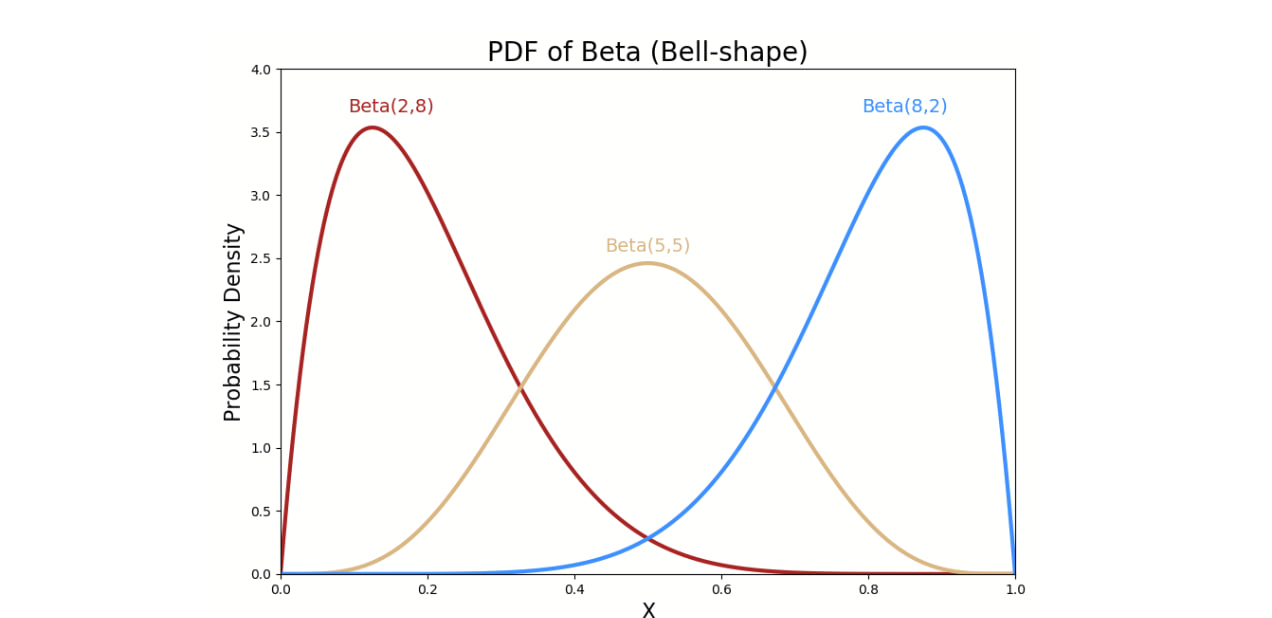
Example: my belief is that Google Search has a relatively low adstock — that channel’s effect dissipates quickly over time. To express that belief, I will assign a distribution matching it to the adstock parameter or parameters. If I use the geometric series to model adstock, I can for instance assign a Beta(2,8) distribution to the parameter theta, the geometric series’ only parameter. That distribution reflects my belief that the adstock is small.
At year equal mean, the larger α + β, the more assertive the prior
Probability density of the beta distribution over the interval 0 to 1, the range of a parameter such as θ, the rate of the geometric adstock. In grey, the three distributions of the original figure; in blue, the one you set. Choose a distribution, then move α and β.
For year MMM: in the article’s example, Beta(2 ; 8) placed on θ, the single parameter of the geometric adstock, expresses the belief that the adstock is small. The mean α / (α + β) says where the model looks for θ; the sum α + β, with how much certainty. Try α = 4 and β = 16: the same mean, a standard deviation of 0.09 instead of 0.12. The more pronounced the belief, the more it weighs against the data — at the risk, the article says, of distorting the observed evidence.
Source: beta distributions computed, parameters from the article’s figure · Chart: Bright
Once priors are assigned to each parameter, the modelling is done through Markov chain Monte Carlo (MCMC), using the NUTS algorithm.
What matters to retain is that the final results can be influenced far more than with Robyn, through the priors. The results are a blend of the observed data and the priors.
Our view as integrators
In general, both Robyn and LightweightMMM have made important progress possible towards a realistic MMM. Although their ways of working differ, both have their advantages and drawbacks.
At Bright we first made extensive use of Robyn. That is because the package, natively compatible with our framework, was available in a mature state earlier, and its documentation is rich. Even calibrating the model coherently, however, we noticed that we sometimes got results calling for more exploration time to raise the model’s relevance — the R2 in particular (R2 = the share of variance the model explains).
One of LightweightMMM’s great strengths is that unrealistic results can be eliminated entirely through the priors. The control the priors give lets you “shape” the results in the direction you want. Practical as that is, it also carries the risk of distorting the evidence in the data too far with beliefs held too strongly. The whole finesse lies in gauging the strength of the priors well, by choosing the right distribution and the right parameters — which is not obvious.
On the other side, Robyn’s creators also noticed that results were sometimes unsatisfactory, and added a way of steering the model towards the results desired. Conceptually that resembles the use of Bayesian methods, though less finely. It lets Robyn reproduce part of LightweightMMM’s advantages.
On features and on visualising the results, Robyn has better capabilities than LightweightMMM. Beyond the relatively complete set of charts produced after the modelling, Robyn offers dependable functions for allocating your budget optimally and for refreshing the model.
Finally, the far thinner Q&A around LightweightMMM discourages its use somewhat. It makes implementation harder and can cause considerable blockages in the face of an unidentified error.
For Bright, where the situation allows, the ideal is to run both models and compare the results. If large differences appear, their causes have to be sought, so as to settle which answers are most likely.
Conclusions
Robyn and LightweightMMM are ambitious projects that have opened the use of complex MMM up “a little”. Using this kind of analysis makes for more efficient use of financial resources and a better understanding of a media mix’s impact.
At this moment neither package has a clear superiority over the other, at least to our mind. For LightweightMMM we find the use of Bayesian methods an interesting avenue. Robyn stands out through the better quality of the package as a whole. In our view, how the packages develop will settle which becomes the more popular among analysts.
Update, September 2026: Google has since announced that its own open-source model, Meridian, will be built into GA360, along with an interface, Meridian Studio.
The series : MMM explained in three chapters


- Marketing Mix Modeling10 publications
The key skills bright can bring to you