

Average position disappears from Google Ads
Julien Masson
· 4 min
Top impression rate and absolute top impression rate now replace the notion of average first position, leaving PPC specialists in a fog of approximations.
Swipe left to read
Keep reading
Top impression rate and absolute top impression rate now replace the notion of average first position, leaving PPC specialists in a fog of approximations.
What are the effects? How do we bounce back and adapt, so as to analyse our campaigns’ positioning and performance?
At the end of September, we were forced to say goodbye to average position, a metric cherished by a whole generation of PPC specialists — especially the older ones who, like me, were already there when ads appeared on a yellow background.
The top of the page counts every ad above the organic results; the absolute position, the first one only
A Google results page in its traditional interface, ads at the top and on the right, redrawn from the screenshot in the article. A diagram, with no data. Choose a metric, or hover, tap or step through a zone of the page with the keyboard.
With the keyboard: Tab, then the arrows to move from one zone to the next.
Source: the screenshot of the traditional interface published in the article; definitions of the two metrics: Google Ads help, as quoted by the article; the 67% share: the article’s study of fifty Google Ads accounts · Chart: bright.swiss
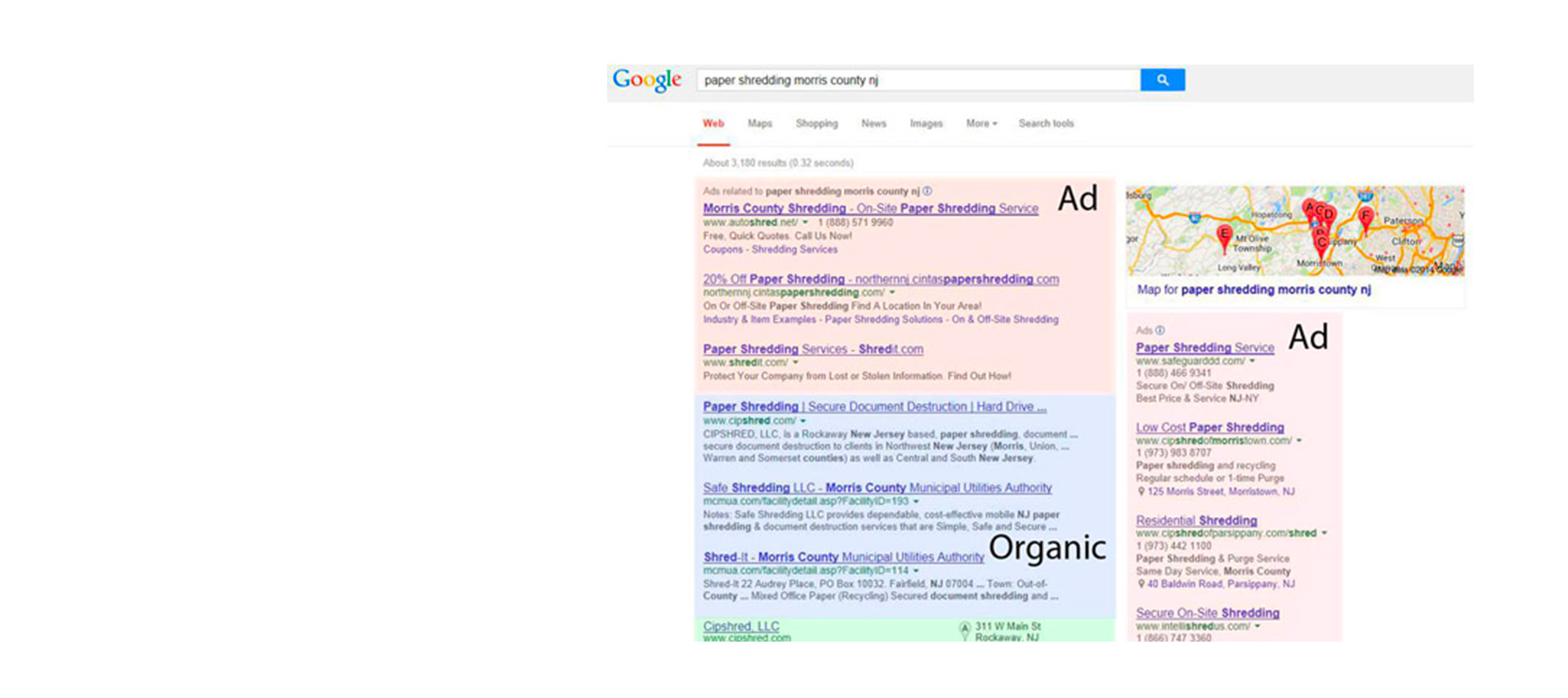
The traditional Google Ads layout — a time those under 20 cannot know.
Let us try to analyse what effect that disappearance has had on our campaigns, after a few weeks in the new world.
Psychological impact: enormous
Clearly the biggest, because I feel I have lost a crucial landmark in the way I read a campaign’s results. As if my GPS suddenly stopped showing the kilometres left to my destination, or the panel showing the score and the clock disappeared from televised football.
Unsettling, is it not?
The new metrics to use — top impression rate and absolute top impression rate — left me feeling lost in a fog of approximations. One more change that takes precision away from what we can analyse, and deepens the black box Google Ads is heading towards.
After passing through every stage of grief — most of it in denial, praying for a last-minute reprieve — I had to resolve to find a new way of analysing our campaigns’ positioning and performance.
Impact on analysis: significant, but…
What clearly made acceptance easier is that, while I was used for years to reading average position to understand at a glance where my ads appeared, average position was never a KPI for optimising campaigns — except for Brand campaigns, and even there, securing 100% impression share needs no average position.
That metric mainly told me which keywords had further volume potential, because their position was low, and which were already placed very high and could therefore generate no further clicks. So we began using the two new metrics meant to replace average position, and in particular tried to set their values against those of average position.
| Average position | Average impr. (Abs. Top) % | Average impr. (Top) % |
|---|---|---|
| 1 | 67% | 71% |
| 1.5 | 43% | 65% |
| 2 | 23% | 59% |
| 3 | 8% | 51% |
| 4 | 3% | 47% |
| 5 | 1% | 27% |
| 6 | 0% | 6% |
Study carried out across fifty Google Ads accounts
The absolute position collapses as early as average position 2; the top of the page holds until 4
Average share of impressions shown at the top of the page (Top) and in the absolute position, the very first ad (Abs. Top), in %, against the keyword’s average position. Fifty Google Ads accounts, autumn 2019. Move the slider to read both shares.
Source: a study carried out on fifty Google Ads accounts, published in the article (December 2019); between two measured positions, values are interpolated · Chart: bright.swiss
It is not easy to read anything precise here, the most puzzling being the keywords at an average position of 1.0 that correspond to an absolute top impression rate of 67%. By the definition of the two metrics that looks impossible: the absolute top impression rate should be 100%. The most plausible explanation is that when those keywords appear, they are indeed in first position, but they were not shown on 100% of the queries.
That is consistent with the reduction of paid spots from 10 to 7 (begun in 2016), which did not reduce the number of advertisers but simply sharpened the competition over fewer places. Google did not exclude the advertisers who appeared in positions 8 to 10; it distributed the impressions of spots 1 to 7 among all advertisers.
The disappearance of average position goes the same way: a bid for a given keyword no longer corresponds to a secured position, because Google may show one of your competitors in that place for the next search. And your ad again for the one after. So we have to think more and more in share of voice (impression share) and no longer in terms of position from first to seventh.
Impact on performance: none
For everyone using automated bidding solutions, the impact was nil, because Google anticipated this disappearance well in advance and told the bidding solution providers very early — including our partner Kenshoo. Bidding algorithms do not need to know the position, because they work from the incremental cost of traffic at each increase in bid.
No impact on that side, because average position, like the new metrics expressed as percentages, is not a performance indicator.
The only possible impact is for those who optimise their campaigns by hand, or with automated rules based on average position. The transition was harder to handle, because as we saw above the new metrics do not replace average position, and no precise equivalence can be established between the two values. But if that is your case, your main problem is not the disappearance of average position — it is that in 2019 you are not using an automated bidding tool.
Conclusion
Looking back, I think I lived through something similar when I was stopped from taking my comfort blanket to school at five years old: a sense of irreplaceable loss and of a world collapsing, forgotten ten minutes later because I had found something else to do.
We saw no impact on performance, and the transition happened without effect. The only thing that worries me a little is Google’s wish to “hide” more and more information, by recommending that advertisers trust the algorithms entirely with their investment.
We are great fans of algorithmic optimisation at Bright, but we prefer to use third-party tools rather than letting Google’s algorithms invest… on Google. One has to hope that the ultimate aim of these changes is not to turn the system into an immense black box which, like Facebook, would significantly limit our ability to make sure every centime is invested in our clients’ interest, and not in that of the GAFA shareholders.
Going further
- Performance management19 publications
- Search and Google Ads11 publications



The key skills bright can bring to you